Trailer tyres fail more often than car tyres, and they fail for reasons that have almost nothing to do with tread wear. A trailer tyre usually has plenty of tread left when it comes apart. It fails because it was old, because it was underinflated, or because it was asked to carry more than its rating at a speed it was never built for.
The short answer: run trailer tyres at the cold pressure stamped on the sidewall, which is typically 50 to 65 psi and much higher than a car tyre. Replace them at five to six years regardless of tread, and keep speed at or below 65 mph unless the sidewall says otherwise.
ST tyres are not car tyres
Most trailer tyres are marked ST, for Special Trailer, ahead of the size. An ST tyre has stiffer sidewalls and a higher load rating for its size than a passenger tyre, because a trailer tyre carries vertical load and resists side forces without ever having to steer or transmit power.
That stiffness is why they run at high pressure, and why fitting a passenger car tyre to a trailer is a genuinely bad idea even when the size matches. A P-rated tyre on a trailer is derated substantially and flexes in ways that encourage sway.
| Marking | Meaning |
|---|---|
| ST205/75R15 | Special Trailer, 205 mm wide, 75% aspect ratio, radial, 15 in rim |
| Load Range B | 4-ply rating, lightest duty |
| Load Range C | 6-ply rating, common on small utility trailers |
| Load Range D | 8-ply rating, common on tandem-axle trailers |
| Load Range E | 10-ply rating, heavy trailers and deckovers |
| M+S | Mud and snow tread pattern, not a winter tyre rating |
Pressure: the sidewall number, cold
This is the single most consequential thing on the page. A trailer tyre is inflated to its maximum cold pressure as stamped on the sidewall when carrying near its rated load, not to some lower comfort pressure borrowed from a car.
- Cold means before driving, or at least three hours after. A warm tyre reads high and tempts you to let air out, which is the wrong move
- Check every tyre every trip, including the spare. A trailer sitting for a month loses pressure
- Underinflation is the main killer. A soft tyre flexes, the sidewall overheats, and the structure separates
- A tyre 10 psi low does not look low on a trailer. Use a gauge, not your eyes or your boot
Why underinflation destroys trailer tyres
Heat. A flexing sidewall generates heat faster than the tyre can shed it, the rubber and the belts separate internally, and the failure happens later at speed with no warning. The tyre that blows on the interstate was damaged in the driveway.
Age kills trailer tyres before tread does
Trailer tyres spend most of their lives stationary, often outdoors, often partly loaded. Ultraviolet light, ozone and freeze-thaw cycling degrade the rubber from the outside while the tread stays deep.
Every tyre carries a DOT date code on the sidewall: the last four digits give the week and year of manufacture, so 3223 means the 32nd week of 2023. Find it before you trust a tyre with a load.
| Age | What to do |
|---|---|
| 0 – 3 years | Normal service, check pressure and condition |
| 3 – 5 years | Inspect closely each season for cracking |
| 5 – 6 years | Replace, regardless of remaining tread |
| Over 6 years | Do not tow on it |
Dry rot shows as fine cracking in the sidewall and at the base of the tread blocks. Once it is visible the tyre is finished. A trailer bought used with “like new” tyres very often has ten-year-old tyres with full tread, which is one of the hidden costs discussed in renting versus buying a trailer.
Load range and why overloading is so easy
Each tyre carries a maximum load at its maximum pressure, printed on the sidewall. Multiply by the number of tyres and you have the axle capacity, which must exceed the loaded trailer weight minus the tongue weight.
Overloading happens most often with dense material rather than bulky material. A trailer half full of gravel is far closer to its limit than a trailer stacked to the roof with furniture, which is why bulk aggregate deserves its own treatment in hauling lumber and building materials.
Speed ratings, which surprise people
Many ST tyres are rated for a maximum of 65 mph, and some older ones for 55 mph. That rating assumes correct pressure and load. Exceeding it builds heat in exactly the way that causes separation.
This lines up with the speed at which towing stability starts to deteriorate anyway. Keeping to 55 to 60 mph is easier on the tyres, easier on fuel, and removes the speed at which sway typically appears.
What a blowout feels like, and what to do
A trailer tyre failure often does not feel like much from the driver’s seat, which is the dangerous part. On a tandem-axle trailer the remaining tyre on that side takes the load and the rig may track almost normally. People drive for miles on a destroyed tyre and then on a bare rim.
- Hold the wheel straight and do not brake hard. The reaction is the same as for sway
- Ease off the accelerator and let the speed fall gradually
- Signal and move to the shoulder once below about 45 mph, as far right as you safely can
- Check both tyres on that side, because the survivor has been overloaded and may be damaged
- Use the spare, and if the second tyre looks heat-damaged, stop there rather than continuing
Watch the mirrors on long stretches. Smoke, a flapping sound, or a tyre that looks visibly different from its partner are all worth a stop. The cost of a failure caught early is one tyre; caught late it is a fender, a wiring loom and sometimes the deck.
Changing one on the roadside
Every trailer rented here goes out with a mounted spare, a bottle jack, a lug wrench and gloves, which is the equipment the job actually needs.
- Chock the opposite wheel before anything else, on both sides if on any slope
- Loosen the lug nuts before jacking, while the tyre still has grip on the ground
- Jack under the frame rail near the spring hanger, never under the axle tube on a light trailer and never under the fender
- On a tandem axle, a plank driven onto under the good tyre lifts the bad one without a jack at all
- Retorque the nuts after about 25 miles, because new seating settles
A ninety-second pre-trip check
- Pressure on all four, cold, plus the spare
- Look at the sidewalls for cracking, bulges or cuts
- Find the date code on a trailer you do not know the history of
- Feel the hubs after the first few miles. Warm is normal, too hot to touch is a bearing, not a tyre
- Confirm the spare is actually inflated, which is the one that is nearly always forgotten
That hub check is worth the habit. A dragging brake or a failing bearing produces heat that destroys a tyre from the inside, and the tyre takes the blame for a problem that was never its own.
Bearings: the other thing that strands trailers
Tyres get the blame for a good share of failures that were actually bearings. A dry or failing wheel bearing generates heat in the hub, that heat travels into the wheel and the tyre, and the tyre fails from the inside with no external sign of the real cause.
- Feel the hubs at the first stop. Warm is normal; too hot to hold your hand on is not
- Listen for a rumble or growl that changes with speed rather than with engine load
- Watch for grease on the inside of the wheel, which means a seal has gone
- Check for play by rocking the wheel top and bottom with the trailer jacked
Bearings are a maintenance item measured in miles and in submersion, which is why boat trailers need them far more often than cargo trailers. On a rental this is handled for you between renters. On an owned trailer it is an annual job that is cheap to do and expensive to skip, and it belongs on the list of running costs in renting versus buying.
Storage is what ages tyres fastest
A trailer that works every week often has healthier tyres than one that sits eleven months a year, which is counterintuitive until you see why.
- Ultraviolet light degrades sidewall rubber continuously whenever the tyre is in daylight
- Flat spotting develops when a tyre sits in one position under load in deep cold
- Ozone cracking accelerates near electric motors and generators
- Sitting partially deflated stresses the sidewall at the same point for months
Mitigating it means covering the tyres or blocking the trailer up off them, keeping them inflated while stored, and moving the trailer occasionally so the contact patch changes. None of that is difficult, and all of it is routinely skipped, which is why so many trailers come out of winter storage with cracked sidewalls and full tread.
The spare, which nobody checks
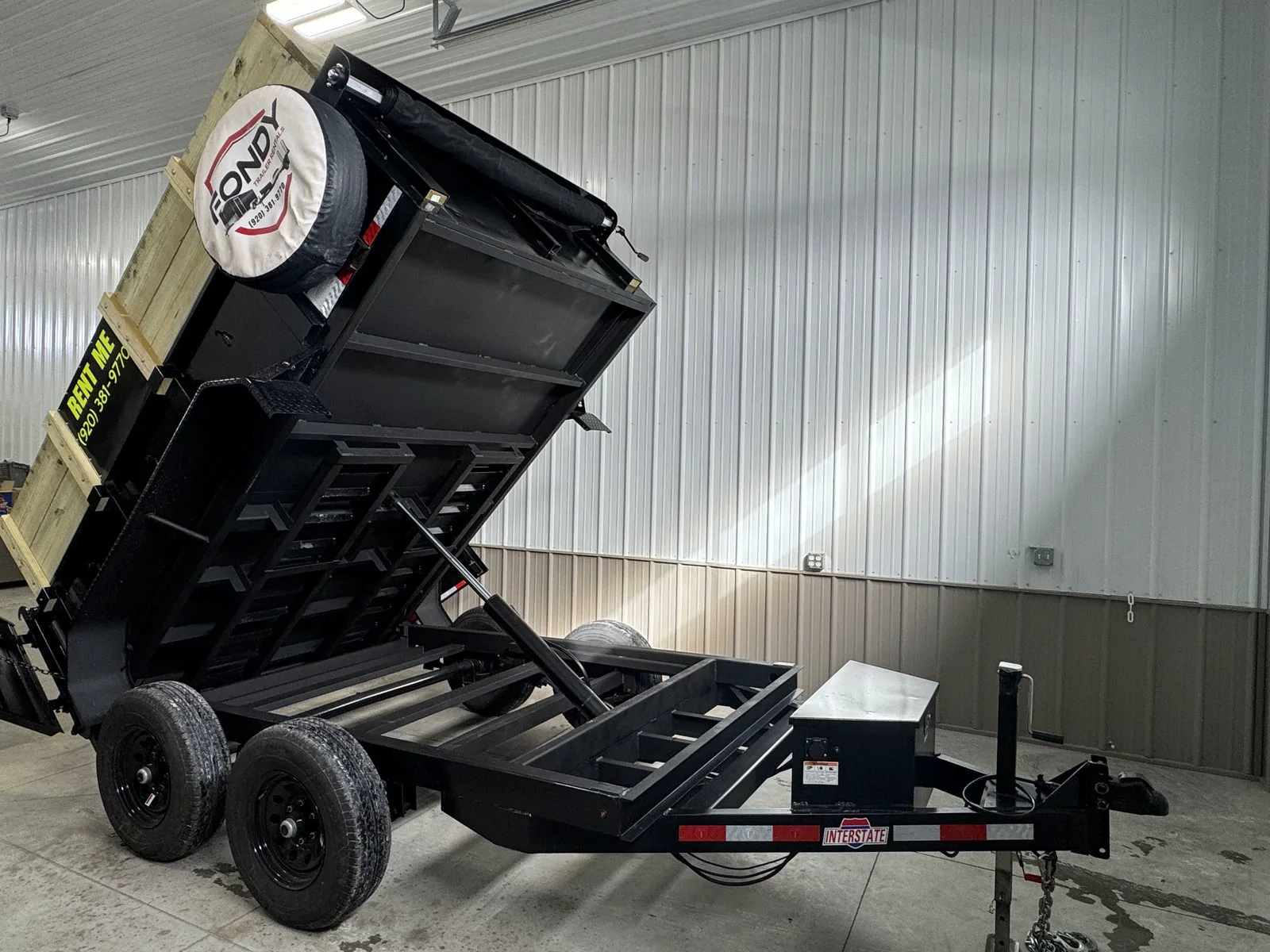
A spare is only useful if it fits, holds air and can actually be removed from wherever it is mounted.
Confirm three things before a long trip. That the spare matches the size and load range of the running tyres, because a mismatched spare on a tandem axle loads the pair unevenly. That it holds pressure, since a spare that has sat for two years is usually soft. And that the mounting bracket releases, because spare carriers rust solid and a seized carrier makes the spare ornamental.
Every trailer rented here goes out with a mounted, inflated spare plus a bottle jack and a lug wrench, which is the combination the roadside job needs.
Pressure through a Wisconsin year
Air pressure falls roughly one psi for every ten degrees Fahrenheit the temperature drops. Between an August afternoon and a January morning that is a swing of around eight psi with no leak at all.
The practical effect: a trailer set correctly in September is meaningfully underinflated by December, which is exactly when a tyre is least able to tolerate it. Cold rubber is stiffer and more prone to cracking, roads are rougher with frost heave, and the loads people haul in winter tend to be dense.
Check pressures at the start of each season and before any long trip, always cold. It takes two minutes with a gauge and it addresses the most common cause of trailer tyre failure before it has a chance to develop.
What this looks like on a rental
Rental trailers get inspected between renters, and tyres are the item checked most closely because they are the item that strands people. Pressures are set, date codes are tracked, and tyres are replaced on age rather than on tread. Every trailer leaves with a spare mounted and inflated.
What still belongs to the renter is the load: keeping it inside the trailer’s rating, and keeping speed sensible. If you are unsure whether your load is within the limits, text Nick at (920) 381-9770 and describe it. It is a two-minute conversation that occasionally saves a tyre and sometimes saves a day.
Keep Reading
- Trailer Maintenance Checklist — the full maintenance checklist