A piano is the hardest household item most people will ever move. It is heavy, the weight is unevenly distributed, the case is fragile where it looks solid, and the part that costs money to repair is the part you cannot see. It is also entirely movable by three or four careful people, provided it is an upright and the route does not involve a turning staircase.
The short answer: uprights stay upright and travel on their back edge against the trailer wall, strapped. Grands come off their legs and travel on a piano board on their bass side. Budget three to four people for an upright, and get a quote from a piano mover before attempting a grand or any piano that has to come down stairs.
What it weighs, which decides everything
People consistently underestimate pianos. A spinet looks like a piece of furniture and weighs as much as a motorcycle.
| Type | Typical weight | Realistic crew |
|---|---|---|
| Spinet upright (36–40 in tall) | 300 – 400 lbs | 3 people |
| Console upright (40–44 in) | 350 – 450 lbs | 3 people |
| Studio upright (45–48 in) | 450 – 600 lbs | 4 people |
| Full upright / grandfather | 500 – 800 lbs | 4 people |
| Baby grand (5 ft) | 500 – 600 lbs | 4 people and a board |
| Grand (6–7 ft) | 650 – 900 lbs | Specialist |
| Concert grand (9 ft) | 900 – 1,300 lbs | Specialist |
Two things follow from this table. A studio upright at 550 lbs is more than two people should attempt regardless of how fit they are, because the failure mode is not dropping it slowly. And anything from a 6-foot grand upwards is genuinely specialist work where the quote is cheaper than the repair.
Why an upright must stay upright
An upright piano can be laid on its back for very short distances by people who know what they are doing, but there is no reason for you to. Upright, the weight sits on the castors and through the frame where the design intends. On its back, several hundred pounds of iron plate and string tension press against the case and the action, and the soundboard takes load it was never built to carry.
The relevant distinction is that a piano is not furniture with strings in it. It is a frame under roughly twenty tons of accumulated string tension, wrapped in a wooden case. The case is what you can see and the frame is what matters.
The one-sentence version
Keep an upright on its castors and its back edge. Keep a grand on its bass side on a board. Never rest the full weight of any piano on its legs during a move, because legs are the first thing to break.
Preparing the piano
- Close and lock the keyboard lid, or tape it closed if there is no lock. A lid that swings open takes fingers with it
- Remove the music desk and anything else that lifts out, and carry those separately
- Wrap the whole case in moving blankets, corners first, and tape the blankets to themselves rather than to the finish
- Do not tape anything to a polished surface. Adhesive lifts lacquer, and that is a refinishing job
- Check the castors. Old castors seize, and a seized castor on carpet is what tips a piano over
Wrap before you move anything, not after. A piano that is already in a doorway is impossible to wrap properly, and the doorway is where the damage happens.
Moving an upright, step by step
The technique is unglamorous and it works.
- Clear and measure the whole route first, including the narrowest turn, not just the doorways
- Two people on the heavy end, which is the end with the pedals and the bass strings, and one steering
- Roll it, do not carry it, wherever the floor allows. Castors exist for this
- Over thresholds, lift just enough to clear and set it down fully before the next move
- One person calls the moves and everyone else stays quiet. Pianos get dropped when two people give instructions
On a grand, the process is different in kind rather than degree: the lid is locked, the legs come off one at a time while the corresponding corner is supported, and the piano rests on its bass side on a padded piano board that is then strapped to a dolly. If you have not done it before, this is the point to call someone who has.
Stairs, which is where to stop and think
A straight flight with a crew of four and a stair-climbing dolly is achievable. A turning staircase with a short landing is where amateur piano moves become expensive, because there is nowhere to set the instrument down mid-turn and nowhere for the crew to stand.
Honest guidance: if the piano has to go down a turning staircase, get a quote. Professional piano movers in Wisconsin typically charge a few hundred dollars for a local move, which is less than the cost of repairing a cracked case or a broken ankle.
Which trailer, and why enclosed
A piano should travel enclosed. It is not only rain, it is road grit, temperature swings and the risk of a strap letting go on an open deck.
| Piano | Suggested trailer |
|---|---|
| Spinet or console upright | 6' x 12' enclosed trailer |
| Studio or full upright | 7.5' x 16' enclosed trailer |
| Baby grand on a board | 7.5' x 16' enclosed trailer |
| Grand, with crew and equipment | 8.5' x 24' enclosed car hauler |
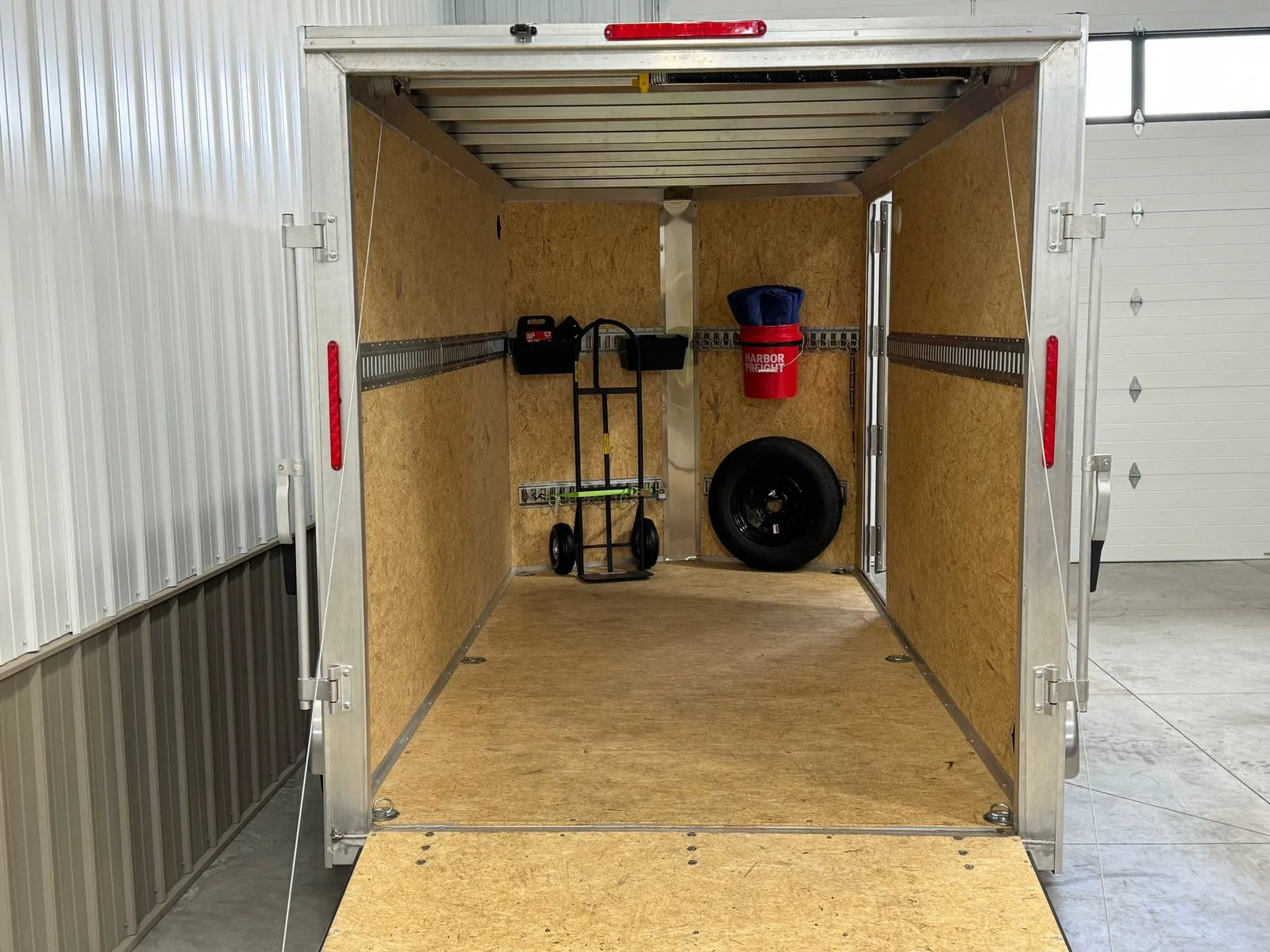
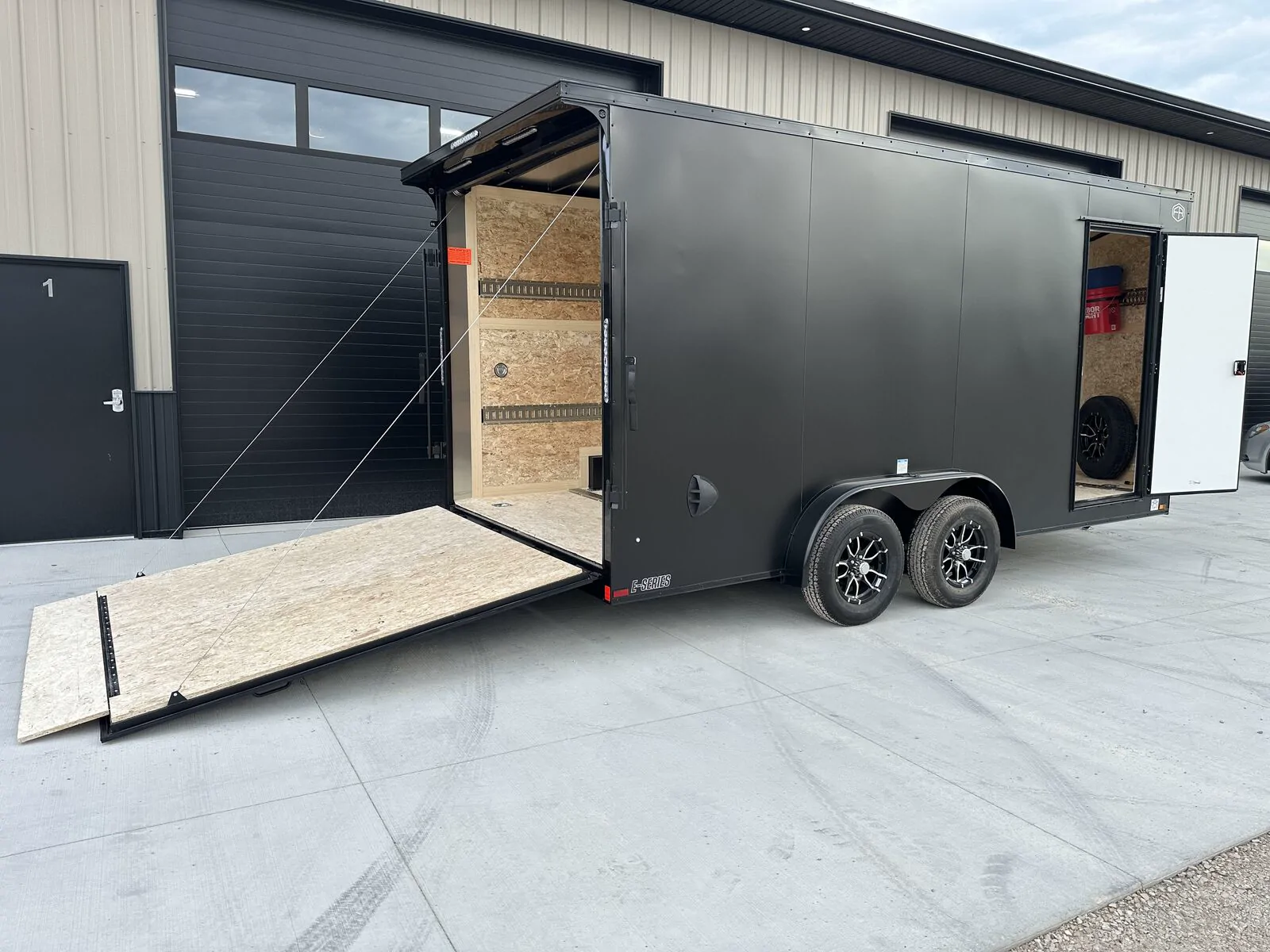
The 6' x 12' enclosed trailer handles most uprights and is the easiest to manoeuvre into a residential driveway. Step up to the 7.5' x 16' enclosed trailer when the piano is tall, when there is other furniture coming too, or when you want room to work around the instrument rather than wedging it in. Both have wall rails to strap to, which matters more than floor space.
Loading and strapping
- Up the ramp slowly, heavy end first, with one person ahead steadying and two behind pushing
- Against the front wall of the trailer, back edge to the wall, so the weight sits ahead of the axle
- Two straps minimum, over the case through the blankets, anchored to the wall rails
- Blankets between the piano and every hard surface, including the wall it leans on
- Nothing stacked against it, and nothing it can slide into
Front wall placement is not just about protecting the piano. Several hundred pounds at the rear of a trailer takes weight off the tongue, which is the direct cause of trailer sway. Heavy goes forward on every load, and a piano makes that rule unusually unforgiving.
After the move: let it settle, then tune it
A piano that has been moved needs tuning, but not immediately. The instrument needs to acclimatise to the humidity and temperature of its new room, and tuning before it has settled means paying twice.
The usual guidance is to wait two to four weeks after the move before booking a tuner, longer if the piano has moved between very different environments, such as a heated house to an unheated room. In Wisconsin the seasonal humidity swing is large enough that where the piano ends up in the room matters too. Keep it off an exterior wall and away from a heat register or a sunny window.
Measuring the route, including the turn
The measurement that stops piano moves is not a doorway width. It is the diagonal through a turn, which no one measures until the piano is wedged in it.
- Measure the piano at its widest and deepest, including the keyboard lid and any overhanging top
- Measure every doorway on the route, and remove doors where the clearance is under two inches
- Measure the landing depth at any staircase turn. A piano needs room to pivot, and a short landing is a hard stop
- Check ceiling height where a stair-climbing dolly will tilt the instrument back
- Walk the route carrying nothing, slowly, looking for the pinch points
Taking a door off its hinges costs fifteen minutes and three screws and buys close to three inches of clearance. Discovering you needed those three inches with 550 lbs balanced on a dolly in a doorway is a different experience entirely.
Protecting floors and thresholds
A piano on castors concentrates several hundred pounds onto four small wheels, which is more than enough to mark hardwood, tear vinyl or crush carpet pile permanently.
Lay plywood or hardboard sheets along the rolling route on any floor you care about, overlapping them so there is no edge to drop off. On carpet, the sheets also give the castors something to roll on instead of ploughing. Outside, plywood over soft ground or a gravel drive keeps the castors from digging in and tipping the instrument, which is the single most likely way a piano ends up on its side.
Thresholds deserve specific attention. A piano rolling at walking pace that hits a half-inch threshold stops instantly at the bottom and keeps going at the top. Lift over every threshold, set it fully down, then resume.
Wisconsin winter, and why it complicates things
Moving a piano between November and March here adds three problems that are easy to underestimate.
- Ice on the route, especially the slope from the door to the driveway, which is where control is lost
- Cold shocks the instrument, and rapid temperature change is harder on a piano than cold itself
- Condensation on arrival, as a frozen piano brought into a warm room collects moisture on the strings and plate
The mitigations are straightforward. Clear and salt the route properly the night before rather than the morning of. Keep the trailer time as short as you can. And on arrival, leave the piano wrapped in its blankets for several hours in the new room so it warms slowly, rather than unwrapping it immediately. That slow warm-up is what prevents condensation forming on cold metal.
What it costs, honestly
A local professional piano move in this part of Wisconsin typically runs a few hundred dollars for a straightforward upright on one level, with stairs, grands and long distances adding to that.
| Approach | Rough cost | Makes sense when |
|---|---|---|
| Fully DIY, rented trailer | Trailer rental only | Upright, level route, four people available |
| Movers to the driveway, you drive | Part labour plus trailer | Stairs at one end, straightforward drive |
| Full professional move | Several hundred up | Grand piano, stairs with turns, or high value |
The hybrid in the middle is underused and is often the right answer. The expensive expertise is in getting the instrument through the doorways and down the stairs, not in driving it fifteen miles. Paying for the hard part and renting the 6' x 12' enclosed trailer for the easy part keeps the cost down without putting the piano or your back at risk.
When to pay someone else
There is no shame in this, and the honest test is simple. Call a professional if any of the following are true:
- It is a grand, of any size, and you have not moved one before
- There are stairs with a turn, in either house
- You cannot field four capable people on the day
- The piano has significant value, sentimental or financial
- The route includes a steep or uneven driveway, which is where rolling becomes running
A reasonable hybrid is common: pay a piano mover to get the instrument from the room to the driveway, then do the transport yourself in a rented enclosed trailer. The expensive expertise is in the stairs and the doorways, not the drive.
If you want to talk through which trailer suits the piano and whatever else is coming with it, text Nick at (920) 381-9770. Related reading: moving large furniture and loading and strapping a cargo trailer.
Keep Reading
- How to Move a Pool Table — moving a pool table