How you load a trailer matters more than what you put in it. A properly loaded 6x12 enclosed pulls like it isn't even there. A badly loaded one sways at 55, chews tires, and wrecks your fuel economy. The physics are simple, but most people never get taught them — they just throw stuff in and hope. This guide walks through the actual rules we tell every renter who picks up an enclosed trailer, utility trailer, or car hauler from our Fond du Lac lot.
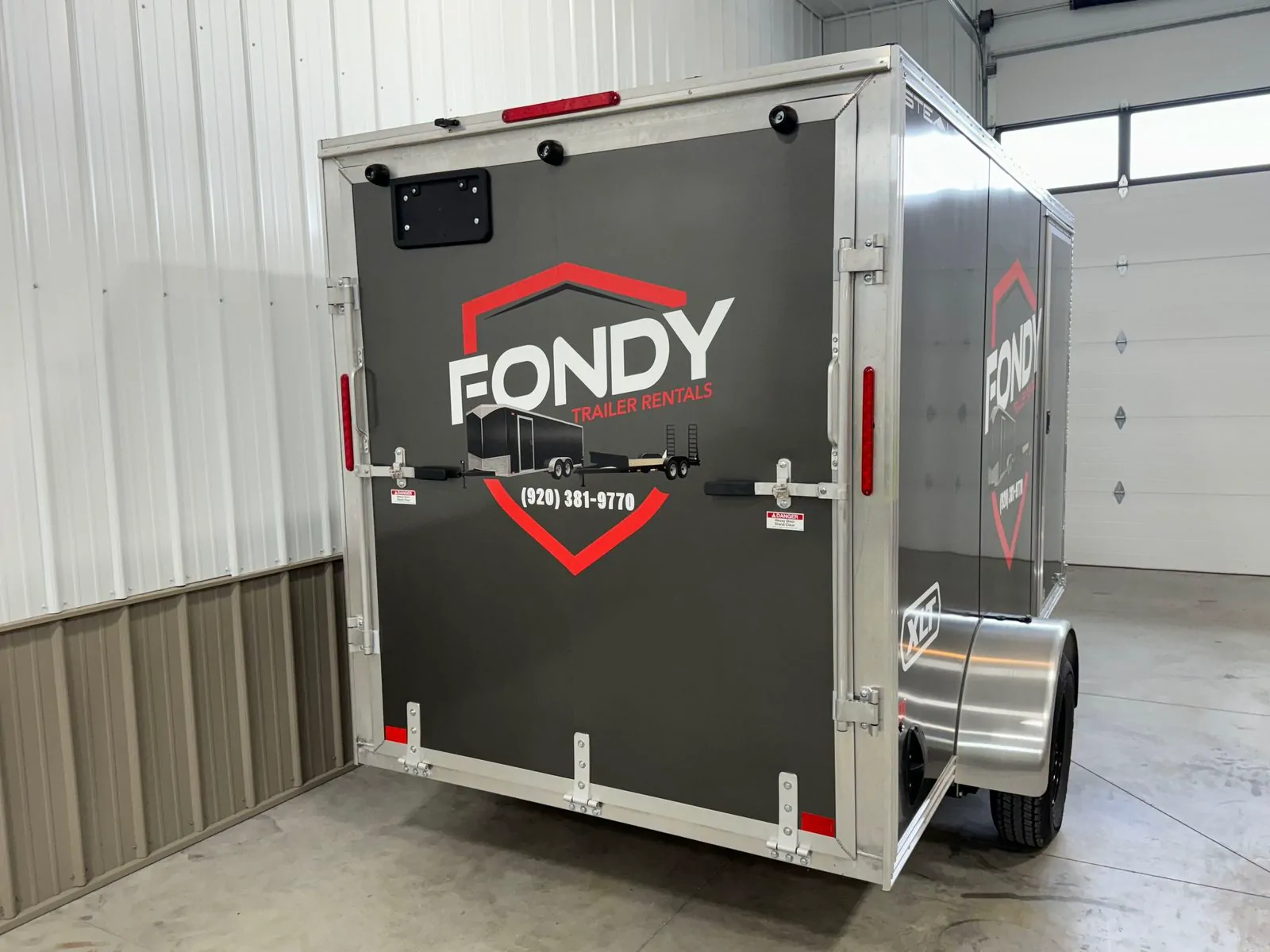
The trailer for this job: Enclosed Trailer — 6' x 12' · dry and lockable. Text Nick at (920) 381-9770 to check a date.
The 60/40 Rule: Weight Forward of the Axle
Roughly 60% of the cargo weight should sit in front of the trailer's axle, 40% behind. Not exactly, but close. This puts enough downward force on the hitch to keep the trailer stable at highway speed and prevents the tail from getting light and wagging.
- Too much weight forward → overloaded hitch, squatting truck, poor steering
- Too much weight rearward → light hitch, sway starts at 45-55 mph, dangerous
- Balanced correctly → the trailer just tracks. You forget it's there.
On our 6x12 enclosed and 6x12 utility, the axle is roughly in the middle. Load the heaviest items just forward of that midline — think washer, dryer, tool chest, motorcycle rear wheel, refrigerator. Lighter stuff (boxes, bedding, plastic totes) fills in around it.
Tongue Weight: The Number Most People Skip
Tongue weight is the downward force the trailer coupler puts on your hitch ball. For a bumper-pull trailer, you want 10-15% of the total loaded trailer weight sitting on the tongue. For gooseneck trailers like our 30+5 gooseneck deckover, the target is closer to 20-25% on the ball.
You don't need a scale for this on smaller loads. Two field tests work:
- Look at your truck. After hitching, the rear should squat a little. If it squats a lot or is nose-high, the load is wrong.
- Lift the tongue by hand. On a 6x12 utility with an empty coupler, you can pick the tongue up. Once loaded correctly, you should not be able to lift it easily. If you still can, too much weight is behind the axle.
Wisconsin sway is real. Highway crosswinds coming across open farm fields near Fond du Lac and Highway 41 will amplify any load imbalance. If you feel sway once, slow down and re-check the load at the next exit. Do not just muscle through it — sway builds on itself.
Loading Order That Actually Works
- Heaviest items first, right over the axle. Get the appliance, safe, tool chest, or engine block loaded before anything else.
- Next-heaviest items in front of the axle. Furniture, filing cabinets, packed totes.
- Light bulky items last, filling in the rear and sides. Mattresses, empty boxes, bedding.
- Strap and tie as you go. Do not wait until the trailer is full — you won't be able to reach the front items.
- Leave nothing loose in an enclosed trailer. Anything that can slide will slide, and it will slide toward the door on a hard stop.
Ratchet Straps vs Cam Straps vs Rope
Ratchet straps
The standard for anything heavy. Our enclosed trailers have D-ring anchors on the floor and along the walls. Ratchet straps let you pull real tension — enough to compress a couch cushion or lock a motorcycle down through its suspension. Do not over-crank; you can crush cargo or snap a strap.
Cam straps
Great for medium-weight items where you don't want ratchet-level force. Boxes, appliance doors, kayaks, furniture. Faster to release than a ratchet, less likely to overtighten and dent something.
Rope
Only if you know your knots. A truckers' hitch on quality rope works. Loose rope with a granny knot is worse than nothing — it gives false confidence and lets the load shift undetected.
Tie-Down Points in Our Trailers
Every trailer in the fleet has real anchor points. Use them.
- 6x12 enclosed: D-rings in the floor near each corner plus wall-mounted tie loops at bed height. Great for stacked furniture and appliances.
- 6x12 utility: Stake pockets around the rail. Use them for lawn equipment, ATV wheel straps, or lumber bundles.
- 18-foot utility: Multiple stake pockets and floor tie points. Enough anchor spread to strap a full-size zero-turn plus two other items.
- 20-foot car hauler: Recessed floor rings sized for wheel straps. Winch mounted at front. Never strap a car through the frame in a way that lets suspension bounce — go through the wheels.
- 8.5x24 enclosed car hauler: Full E-track and floor D-rings. Serious anchor density for classic cars, project cars, and combined haul jobs.
- 8.5x24 tilt deckover: Stake pockets plus rub rail. Skid steer and mini-ex loads get four-corner chained down.
- 30+5 gooseneck deckover: Heavy-duty D-rings rated for equipment loads. Chains preferred over straps for anything over 5,000 lb.
How to Strap Common Loads
Motorcycle
Front wheel in a wheel chock if you have one, or up against the front wall. Two straps to the handlebars pulling forward and outward, compressing the front suspension about a third of its travel. One rear strap to the frame or subframe (never through plastic). Do not strap through mirrors or plastic bodywork.
Riding mower / zero turn
Load with the heavy end forward (engine end). Chock both drive wheels. Two straps front, two straps rear, cross-pattern preferred. Set the parking brake.
Appliances
Upright, tied to the front wall of the enclosed trailer. Blanket wrap under the strap so the ratchet doesn't dent stainless. Do not lay a refrigerator on its side.
Furniture
Sofa on end (short side down) is the biggest space-saver. Wrap in furniture blankets, strap to the wall, avoid pressing the strap directly on upholstery corners.
Vehicle on the car hauler
Wheel straps at all four corners. Use the winch to load a non-runner — do not push a car up the ramps by hand. Chock at least the rear wheels before you release the winch.
Re-Check After the First 15 Minutes
Straps stretch. Cargo settles. Blankets slip. After the first 15 minutes of driving, pull off somewhere safe and re-tension every strap. This one step catches 90% of "the load shifted" problems before they turn into damage. Do it again after the first hour on the highway if you are running the enclosed trailer full for a long move.
Book the Right Trailer for the Job
Text Nick at (920) 381-9770 with what you are hauling — he'll tell you which trailer is the right fit and what straps to bring. If you need ratchet straps or wheel straps, ask ahead of time. Fond du Lac pickup, no mileage limits, and a quick loading walkthrough are all part of the deal.
Frequently Asked Questions
How should weight be distributed in a cargo trailer?
Roughly 60 percent of the load ahead of the axle, heaviest items low and over or just in front of it. Too much weight at the back is what starts trailer sway.
Do straps come with the trailer?
Every trailer goes out stocked: ratchet straps, D-rings, ramps, a spare tire, bottle jack, lug wrench and work gloves. You do not need to bring hauling gear.
Ratchet straps or cam straps?
Ratchet straps for anything heavy or that must not move. Cam straps are fine for light, soft loads where a ratchet would crush what you are tying down.
How often should I re-check the straps?
Check them after the first few miles and at every stop. Loads settle, and a strap that was tight in the driveway is often loose by the edge of town.