Moving a safe is where every logistics decision matters. Safes are dense, top-heavy, unforgiving of tipping, and heavier than they look. A modest 30-inch home safe hits 500 lbs. A gun safe with fire rating pushes 800-1,200. A commercial floor safe is 1,500 lbs and up. None of that weight is distributed like normal cargo — it's all packed into a small rectangular footprint, which means high pressure on whatever's underneath. Trying to muscle a safe up a standard trailer ramp is where most safe-moving injuries and equipment damage happen. This guide covers the correct trailer choice, the loading procedure, and the tie-down technique for getting a safe from A to B without hurting anyone.
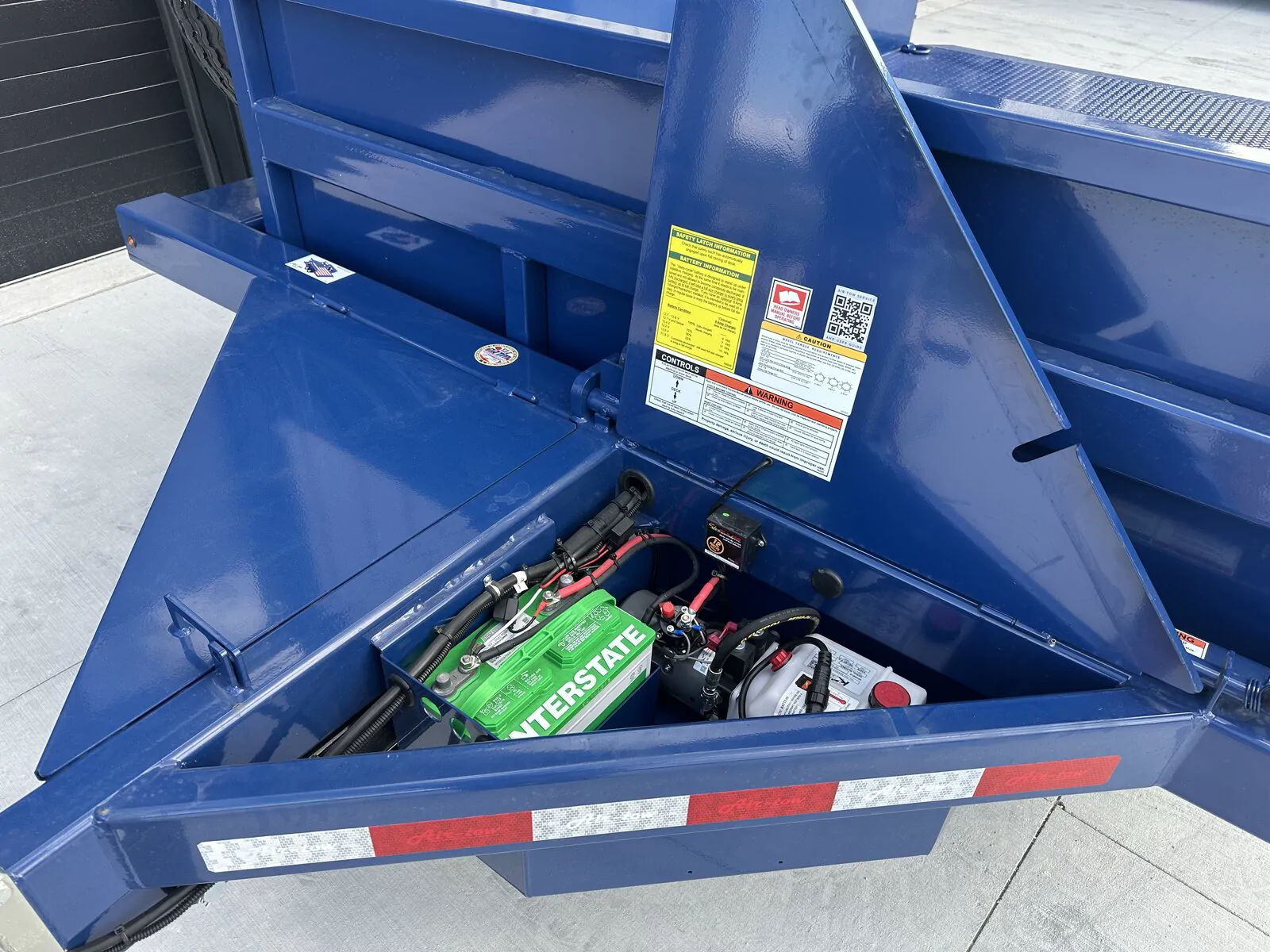
The trailer for this job: Air Tow Utility Trailer — deck lowers to the ground. Text Nick at (920) 381-9770 to check a date.
Why Ramps Fail for Safes
Three specific problems come up on standard-ramp trailers:
- Ramp deflection under load. Ramps are rated for wheeled vehicles, not point loads. A 1,000 lb safe on a small dolly puts 500 lbs on each of two wheels. The ramp can bounce, spring, or crack under that concentrated weight.
- Dolly slip on the ramp angle. An appliance dolly at a 22-degree ramp angle wants to slide backward. The person controlling it becomes the emergency brake, which is not a plan.
- Tipping vector at the transition. When the safe crosses the top of the ramp onto the deck, the balance point shifts. A tall safe wants to keep tipping forward. This is where safes fall off trailers.
Ground-load eliminates all three. No ramp, no angle, no transition. You roll the safe straight from ground to deck.
The Air Tow Is the Right Trailer for Safes
Fondy's Air Tow drops its deck to ground level via air suspension. For safe moves, this changes everything:
- Zero-degree approach: the pallet jack or appliance dolly rolls flat.
- 9,885 lb payload: handles any residential safe and most commercial units.
- 13,535 lb GVWR with electric brakes on all axles.
- Deck about 6.5 x 14 feet: plenty for a safe plus tools plus a helper.
- Wireless remote: raise and lower without leaving the load unattended.
- Wheel nets, chains, and ratchet straps included.
The Right Equipment for Loading a Safe
Pallet Jack (Best Option)
Most home and business safes ship on wooden pallets. If yours is still on its pallet, a pallet jack is by far the easiest way to move it. Pallet jacks work only on flat surfaces, which is exactly what the Air Tow provides. Rent a pallet jack from a local tool rental (Menard's, Home Depot, or a Fond du Lac tool rental yard) for $30-50.
Appliance Dolly (Second Best)
Two-wheel appliance dollies with straps work for safes off their pallets. The safe stays vertical, strapped to the dolly, tilted 15 degrees backward against the dolly's weight. Practice moving the safe on flat ground before attempting to load.
Four-Wheel Dolly (For Wide Safes)
Wide floor safes and short-and-fat units ride better on a four-wheel dolly than a two-wheel appliance dolly. Still requires a flat approach.
Never: Roller Bars and Improvised Setups
Metal pipes as rollers work in cartoons. In reality they slip, roll away, and put your fingers under a 1,000-lb load. Don't.
Absolutely critical: safes are top-heavy. A 60-inch tall gun safe has its center of gravity 30 inches up. Any tip past 15 degrees becomes a runaway. Move slowly, control the load with two people minimum, and never work alone.
Loading Procedure
- Position the Air Tow with the deck at ground level. Level ground is essential. If the site pitches, back the tow vehicle to the flattest section.
- Set the tow vehicle's parking brake and chock the tires. The trailer must not roll during loading.
- Roll the safe onto the deck slowly. One person guides the front, one person stays behind to prevent runback. On a pallet, the pallet jack handle stays in your control the entire time.
- Position centered on the deck. Center of gravity slightly forward of the trailer's axle centerline for correct tongue weight.
- Lower the safe from dolly or pallet jack. If it was on a pallet jack, lower the fork so the safe rests on the deck. If on a dolly, tilt the dolly out from under carefully.
- Set the parking brake on the dolly if it has one, and keep it in place until strapped.
- Raise the deck to travel height. Air suspension raise. Confirm the safe hasn't shifted.
Tie-Down Technique for a Rectangular Top-Heavy Load
Safes need a tie-down that resists three motion vectors: forward and rearward from braking and acceleration, side-to-side from lane changes and turns, and vertical from bumps. The right pattern:
- Two straps horizontally across the top, one near the front, one near the back. These resist tipping.
- Two straps in a cross-pattern across the front and back of the safe, connected to trailer D-rings on opposite sides. These resist forward, rearward, and lateral motion.
- Blocking on all four sides — 2x4s or wood cribbing wedged between the safe and the deck edges. Prevents any small movement from becoming a large one.
- Padding under all strap contact points. Straps against sharp safe edges will fray and eventually fail. Use rubber pads, cardboard, or purpose-made strap corners.
Tongue Weight and Tow Vehicle
Loaded, the Air Tow plus a 1,000 lb safe is around 4,650 lbs total. Tongue weight at 10-15% is 465-700 lbs. That's within a half-ton pickup's tongue weight rating with a properly rated ball and hitch. For a very heavy commercial safe (1,500+ lbs), a 3/4-ton pickup is the right call.
Route Planning
Plan the route to avoid sharp turns at low speed — that's when top-heavy loads want to tip. Highways are better than narrow residential streets. Where possible, avoid dips, potholes, and abrupt braking. The Air Tow's air suspension helps ride quality but doesn't eliminate physics.
Pricing
- Air Tow: $250 / 4 hr, $300 / 24 hr, $720 / 3 days, $1,260 / week
Pickup at W4637 Lakepark Drive, Fond du Lac, WI. No mileage limits. Text Nick at (920) 381-9770 with the safe's weight, dimensions, and your route so he can confirm the trailer works for your specific move.
FAQ
How heavy of a safe can the Air Tow move?
Up to 9,885 lbs of payload. Any residential or gun safe is well within range. Commercial floor safes are also fine unless you're moving something truly enormous (bank-vault class).
Do I need a pallet jack?
If the safe is on a pallet, yes — or an equivalent tool. If it's already off the pallet, an appliance dolly plus a helper works fine on a flat deck. Rent the pallet jack from a local tool rental yard.
Can I load a safe with one person?
Not safely. Minimum two people. Safes shift unexpectedly and you need a second set of hands (and eyes) at all times.
What about the destination — how do I unload?
Same procedure in reverse. Drop the Air Tow deck to ground level, roll the safe off with the pallet jack or dolly, position at the final location. Ground-level unloading is where the Air Tow really shines — you're never lifting the safe over a step or ramp.
Can I move a safe in a pickup truck bed?
Technically yes, if the safe is small and the truck is rated for it. Practically, no — pickup bed height means lifting the safe 3 feet vertically, which is a much bigger problem than rolling it onto a ground-level Air Tow.
Does the trailer come with a pallet jack?
No. The Air Tow includes wheel nets, straps, chains, chocks, and a spare tire. Pallet jack rental is separate.
What about extremely valuable safes?
For a high-value safe with delicate contents, consider hiring a professional safe mover with insurance coverage. Fondy provides the trailer; the safe mover provides the expertise and the liability policy.