Loading a golf cart on a trailer isn't hard the way lifting an engine block is hard, but it's the kind of job where a small mistake ruins expensive things fast. Carts have hard tires that slip on steel ramps, weak brakes that were designed for level fairways, and body panels that snap if a ratchet strap goes in the wrong place. This guide walks through the step-by-step procedure that keeps loading safe and boring — the way it should be. We'll cover trailer setup, cart preparation, the loading procedure itself, tie-downs, and the mistakes we see people make repeatedly at pickup.
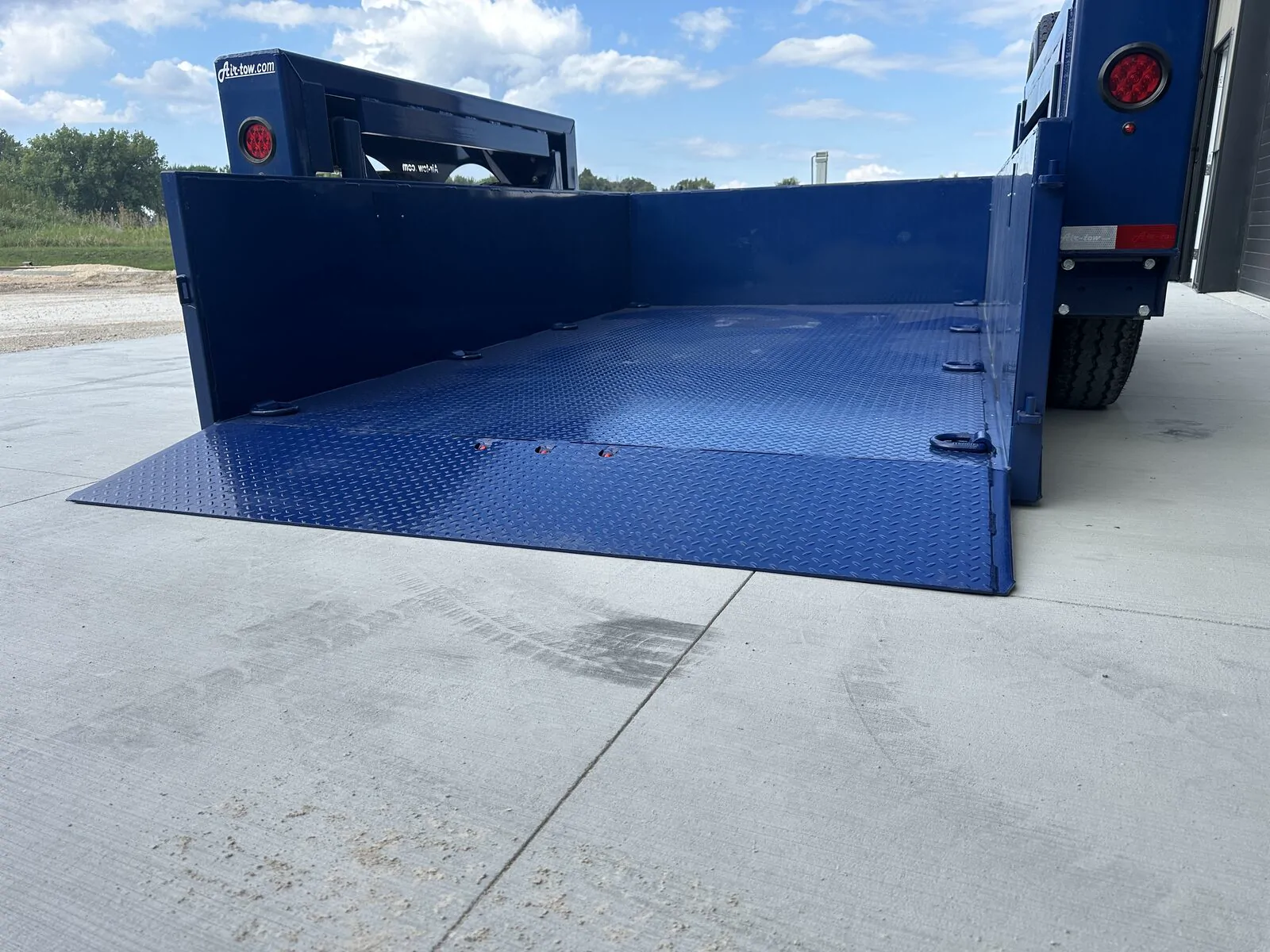
The trailer for this job: Air Tow Utility Trailer — deck lowers to the ground. Text Nick at (920) 381-9770 to check a date.
Before You Start: Trailer and Site Setup
Pick a Flat, Level Site
Loading on a slope is where the vast majority of golf-cart accidents happen. Even a slight grade changes the ramp angle and reduces cart braking. If you're loading in a driveway with any pitch, back the truck onto the flattest section available. If you're at a country club or cottage, ask if there's a flat spot near the storage shed where you can set up.
Ramp or Ground Load
For a standard utility trailer with ramps, deploy them and make sure both ramps are seated fully into the trailer deck lip. Look for the safety pin or lock. For the Air Tow, drop the deck to ground level before you start — don't try to load with the deck partially raised. The whole point is a flat approach.
Chocks and Parking Brake on the Tow Vehicle
Set the truck's parking brake, put it in park (auto) or first gear/reverse (manual), and chock the truck's wheels if the site isn't perfectly flat. The trailer should be attached to the ball with the safety chains crossed and the breakaway cable connected.
Prepare the Cart
Charge Check
You need enough charge to drive the cart onto the trailer under its own power. A near-dead battery pack can hesitate at the worst possible moment — mid-ramp. Ideally, roll on with 40%+ state of charge, or plan to push if it's fully dead.
Remove Loose Items
Coolers, clubs, umbrellas, phones, sunglasses. Anything that isn't bolted down goes in the truck cab. Even at 35 mph on a rural Wisconsin road, loose gear flies out of an open-top cart.
Roof and Windshield
Bolted-on hard tops stay. Clip-on soft tops come off. Windshields in the up position are fine at highway speed for factory installations. Aftermarket windshields sometimes flap — latch them or fold them down.
Step-by-Step Loading Procedure
- Approach the trailer straight on. Aim the cart perpendicular to the trailer, dead center on the deck. Angled approaches are the #1 cause of a tire going off the ramp or missing the deck edge on the Air Tow.
- Use a spotter. One person on the driver seat, one person standing to the side (not behind) watching the wheels. The spotter calls "left," "right," or "stop." No back-of-the-cart spotters — that's how people get hurt.
- Select forward gear. Pull the forward/reverse lever fully into F. Confirm it clicked in. Golf cart drivetrains hate being caught between gears.
- Roll on slowly. Feather the accelerator. On the Air Tow with a ground-level deck, this is easy — you're rolling on flat pavement. On a ramp trailer, momentum matters (enough to climb, not so much that you overshoot).
- Position centered on the deck. The cart's center of gravity should sit slightly forward of the trailer's axle centerline. That puts 10-15% of the loaded weight on the tongue, which is the correct tongue weight percentage.
- Stop, F/N/R lever to neutral or reverse. Pull the forward/reverse lever out of F. Set to neutral (or reverse, whichever the model specifies for parking).
- Set the parking brake. Firmly. Confirm it holds by trying to push the cart gently — it shouldn't move.
- Turn off the key. Remove the key from the ignition. Some carts freewheel with the key on.
- Step off carefully. Use the trailer deck as your dismount, not the cart's step — the step's height off the deck varies.
Four-Corner Tie-Downs
The correct tie-down is four straps, one at each corner, angled outward:
- Front left and front right: straps run from the trailer's forward D-rings to the cart's front A-arms or front axle points. Angled outward and downward.
- Rear left and rear right: straps run from the trailer's rear D-rings to the cart's rear axle housing or frame. Angled outward and downward.
- Wheel nets are the pro option. They cinch over each tire and eliminate the strap-placement guesswork entirely. Air Tow rentals include wheel nets.
- Tighten evenly. Snug each strap so the cart's suspension compresses slightly. Don't crank them so tight the tires deform.
Never strap through the plastic body. The rear splash panel, the front hood, the roof supports, the fiberglass rocker panels — none of these are structural. A strap through a plastic panel will pull the panel through the mounting hardware and leave the cart loose on the trailer.
Common Mistakes to Avoid
Angling the Approach
The single most common mistake. Any angle at the ramp or deck edge means one tire hits differently than the other. Straighten out before you start rolling.
Over-Tightening Straps
Overtightened straps deform the tires, compress the suspension to bottom, and put load on components that weren't designed for it. Snug is right; "as tight as I can get it" is wrong.
Strapping Through Plastic
Covered above but worth repeating. Frame and axle only.
Skipping the Parking Brake
Straps alone will keep a cart from moving in a straight line, but they won't stop it from rocking. Parking brake plus straps plus F/N/R in neutral is the belt-and-suspenders approach.
Loading With the Key On
Some carts freewheel with the key on and can start rolling if a strap slips. Key off, always.
Loading Alone the First Time
Bring a spotter. Ten minutes of extra help is worth avoiding a scratched paint job or worse.
Unloading Procedure (In Reverse)
Reverse the loading sequence:
- Site check for level and clearance.
- Deploy ramps or drop the Air Tow deck.
- Loosen straps evenly.
- Get in the cart. Key on, F/N/R to F, release parking brake.
- Roll off slowly and straight.
- Stow the straps and ramps before driving away.
Book the Trailer
Air Tow ground-load is the easiest option for golf carts. Pricing: $250 / 4 hr, $300 / 24 hr, $720 / 3 days, $1,260 / week. Pickup at W4637 Lakepark Drive, Fond du Lac, WI. No mileage limits. Text Nick at (920) 381-9770 with your cart model and dates. More detail on trailer fit in the golf cart trailer rental guide.
FAQ
Can I load a golf cart by myself?
Yes, with the Air Tow it's genuinely a one-person job. With a ramp trailer, a spotter is strongly recommended, especially the first time.
What if my cart doesn't roll under its own power?
A dead cart pushes onto a ground-level Air Tow easily with two people. On a ramp trailer, you'll need a winch or three helpers. Mention it at booking.
How tight should the tie-down straps be?
Snug enough to compress the suspension slightly. If the tires visibly deform, you're too tight. If you can rock the cart with your hands, you're too loose.
Do I need to remove the batteries?
No. Batteries stay in the cart for transit. Make sure the battery hold-down straps are secure inside the cart.
Can I load a lifted cart the same way?
Same procedure, but note the total loaded height. A 6-inch lift with 23" tires adds significant height — confirm you clear garages and drive-throughs.
What about a lithium battery cart?
Same loading procedure. Lithium packs are lighter than lead-acid, so total weight is often less. Battery Management Systems don't care about transit.
How long does the whole loading process take?
10-15 minutes on the Air Tow if you're familiar. 20-30 minutes on a ramp trailer. Budget more time for your first attempt.