If you've ever tried to load a skid steer, a Bobcat, a piece of construction equipment, or a low-clearance vehicle onto a standard car hauler, you know the problem. The approach angle is too steep. The ramps shift. The machine high-centers halfway up. You're either chaining and winching or you're calling someone with the right trailer. A tilt deckover solves all of that. The entire deck pivots, becomes the ramp, and your equipment rolls on at a fraction of the angle of a traditional flatbed. Here's everything you need to know before you rent ours.
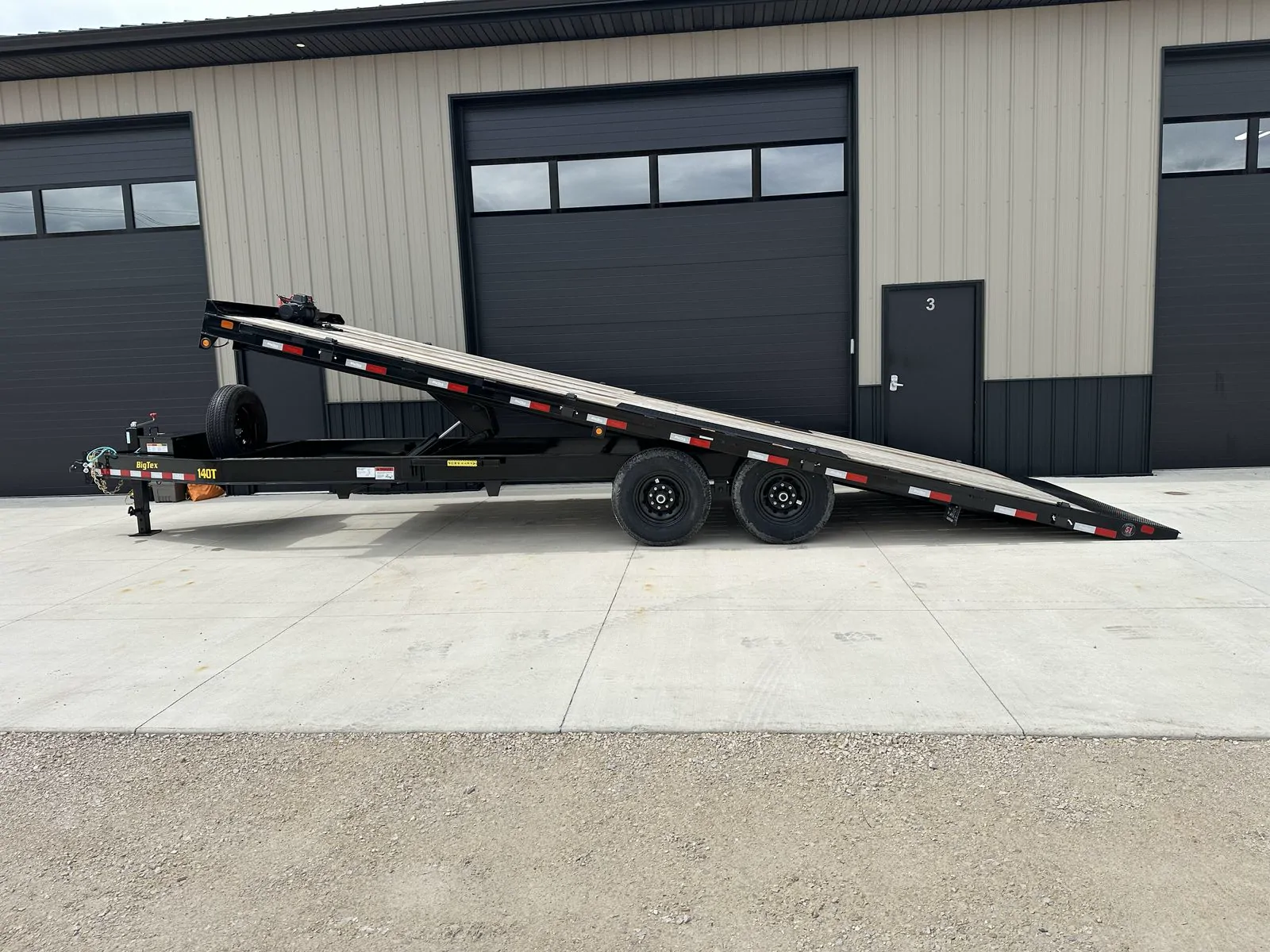
The trailer for this job: Tilt Deckover — 8.5' x 24' · low load angle. Text Nick at (920) 381-9770 to check a date.
What Is a Tilt Deckover Trailer?
A tilt deckover is a flatbed trailer where the deck sits above the wheels (the "deckover" part) and tilts hydraulically (the "tilt" part) so the back end of the deck drops to ground level. There are no separate ramps to deploy — the deck itself becomes the ramp. Drive your equipment up, the deck levels back out, you strap down, and you're rolling.
Our unit is an 8.5' x 24' tilt deckover with 14,000 lb GVWR, electric brakes, a wireless-remote winch, and a full vehicle tie-down kit. Deckover construction means a wider, flatter usable deck than between-the-wheels flatbeds — full 8.5 feet of width with nothing in the way. That extra width is the difference between fitting a wide piece of equipment or not.
What Fits on the 8.5' x 24' Tilt Deckover
Skid Steers and Compact Track Loaders
Skid steer hauling is the single most common reason this trailer gets rented. A Bobcat S590 / S650, Cat 246 / 262, Kubota SVL75, John Deere 318/319/320 — all of these load easily on an 8.5-foot-wide deck with room left for an attachment or two. The tilt deck eliminates the steep-ramp problem that makes loading short-wheelbase tracked machines on a standard car hauler genuinely dangerous. Lower angle, fewer slips, no high-centering.
If you've got the machine plus a bucket and a forks attachment, both can ride on the deck behind it. Strap everything independently — chains across the corners of the machine, ratchet straps across the attachments. Use the D-rings spaced along the deck.
Mini Excavators
A 3.5-ton to 6-ton mini excavator typically fits with weight to spare on the 14K GVWR rating, though always check the spec sheet for your specific machine. The low approach angle is critical here — excavator tracks have very limited articulation and a standard car-hauler ramp angle can stress the undercarriage or cause the boom to drag during loading.
Side-by-Sides, UTVs, and ATVs (Multiple)
One UTV easily fits on a smaller utility trailer, but if you're hauling two side-by-sides — or a side-by-side plus an ATV plus gear — the 8.5' x 24' deck has the room. Wisconsin trail riders heading up to Northwoods systems frequently book this trailer for multi-machine trips. Park them nose-to-nose or staggered, strap each one independently, and you've got room for fuel cans and gear between them.
Cars and Trucks (Including Low-Clearance Vehicles)
The tilt deck shines for loading low-clearance vehicles — sports cars, lowered trucks, project cars that don't run. Where a standard car hauler ramp angle would drag the front bumper or scrape the exhaust, the tilt deck's gentle approach lets these vehicles roll on without damage. Combined with the wireless-remote electric winch, even a non-runner on flat tires can be pulled aboard without anyone fighting a hand crank in the rain.
Lawn and Landscape Equipment (Bulk Hauls)
For landscaping contractors hauling a zero-turn mower, a walk-behind, a hand mower, trimmers, blowers, and a wheelbarrow to a job site — the 24-foot length and 8.5-foot width means it all goes in one trip. Park the zero-turn forward, walk-behinds and equipment in the back half, secured to the D-rings.
Building Materials and Lumber
Picking up lumber, framing materials, sheets of plywood, or stacked decking from a lumberyard? The full 8.5-foot width handles standard 8-foot sheet goods crosswise. The 24-foot length carries 20-foot framing lumber with overhang to spare. This isn't the right trailer for loose gravel or aggregates — that's the dump trailer's job — but for organized stacked loads it's excellent.
Hot Tubs, Sheds, and Bulky Cargo
A standard hot tub is roughly 7 feet square. A small shed is typically 8 feet wide. Both fit on the deckover with the tilt making loading from a moving company's lift gate or a forklift much easier than getting cargo over the wheel wells of a between-the-wheels trailer.
How the Hydraulic Tilt Works
The tilt mechanism is the trailer's signature feature, and operating it correctly matters:
- Position on level, solid ground. The tilt mechanism transfers a lot of force through the pivot point. Tilting on uneven ground or soft surface puts unnecessary load on the cylinder and can cause the trailer to shift sideways.
- Disengage the locking pin. The deck is held flat for travel by a locking pin or latch. Remove or release it before tilting. Nick walks you through the specific mechanism at pickup.
- Activate the hydraulic system. The 12V hydraulic pump runs off your tow vehicle's electrical system. The control raises and lowers the deck smoothly.
- Drive the load on slowly and centered. Centered loading keeps the trailer balanced and the tongue weight in spec. Spotters are useful if you can't see the wheels — tracked equipment especially.
- Lower the deck completely and reinsert the locking pin before driving. Never tow with the deck unlatched. Even a slightly raised deck is unstable at highway speed.
Critical: Always confirm the locking pin is fully engaged before pulling onto the road. A deck that tilts mid-transit becomes a runaway load and a serious hazard to anyone behind you.
Weight Limits and Tow Vehicle Requirements
The 8.5' x 24' tilt deckover is rated at 14,000 lb GVWR. That's the maximum the trailer plus cargo can weigh — it is not the cargo capacity. Subtract the trailer's empty weight (roughly 3,500-4,000 lbs depending on options) to get your usable payload, which is typically around 10,000 lbs.
For a tow vehicle, you need:
- A 3/4-ton or 1-ton pickup (F-250 / Ram 2500 / Silverado 2500HD or heavier) when loading anywhere near the trailer's capacity. A half-ton truck can pull the empty trailer, but it is not enough vehicle for a fully loaded skid steer or mini-ex.
- A 2-5/16" ball rated for the loaded trailer weight — do not use a 2" ball on a 14K-rated trailer.
- A working brake controller in your tow vehicle. Wisconsin requires trailer brakes on any trailer over 3,000 lbs gross weight, and this trailer's electric brakes need a controller to activate them. We rent a Bluetooth brake controller if your truck does not have one built in.
- A weight-distributing hitch is not required for the tilt deckover — the deckover design keeps tongue weight reasonable — but adequate tongue weight capacity at your receiver is still essential.
Wisconsin Road Rules for the Tilt Deckover
A few specifics for towing this trailer in Wisconsin:
- Brake controller required. Anything over 3,000 lbs gross trailer weight needs trailer brakes wired to a controller. This is not optional.
- Width considerations. The trailer itself is 8.5 feet wide — within the standard Wisconsin width limit of 8'6" — but cargo that overhangs the deck width requires an oversize-load permit. If your equipment is wider than 8'6" when loaded, talk to Nick before you book.
- Spring road postings. Many Wisconsin county roads carry spring weight restrictions (typically March through May). A loaded 14K trailer can exceed posted limits during spring thaw. Check Fond du Lac County Highway Department postings before route planning during these months.
- Tie-down requirements. Wisconsin and federal cargo securement rules require a minimum of four independent tie-downs on heavy equipment, with chains and binders for anything over 10,000 lbs. Our trailer comes with the necessary chains, binders, and ratchet straps.
What's Included With the Rental
- Full-size spare tire, bottle jack, and lug wrench
- Tool kit and work gloves
- Heavy-duty wheel chocks
- Vehicle tie-down kit with ratchet straps
- Chains and binders for heavy equipment
- Wireless-remote electric winch (rated for non-running vehicle recovery)
- Ten D-rings spaced along the deck
- Electric trailer brakes (controller required in tow vehicle)
Pricing
The 8.5' x 24' tilt deckover with winch (14K) rents at:
- $120 / 4 hours
- $140 / 24 hours
- $355 / 3 days (15% off)
- $735 / 1 week (25% off)
For multi-week or contractor recurring use, text Nick at (920) 381-9770 to discuss — there's often room on the rate for repeat customers and long jobs.
Tilt Deckover vs. Standard Car Hauler — Which Do You Need?
Both trailers haul vehicles, but the use cases diverge. Use the tilt deckover when:
- You're moving heavy equipment that won't load up a standard ramp angle (skid steers, mini-ex, lifted/lowered vehicles)
- You need width — the 8.5-foot deck handles equipment a 7-foot car hauler simply cannot
- You want one trailer for vehicles, equipment, building materials, and bulky cargo without swapping units
- You're loading without help — the tilt deck and remote winch make solo loading practical
Stick with the 20-foot car hauler when:
- You're hauling running cars or trucks that load fine on a standard ramp
- You want a lighter trailer and a smaller tow vehicle (a half-ton truck is fine for the car hauler)
- Cost is the priority — the car hauler rents for less
FAQ
Can I rent this for a single skid steer move?
Absolutely. The 4-hour rate at $120 covers most local skid steer moves with time to load, transport, and unload. Block out enough time to load and strap properly — it's better to rent a 24-hour window for $140 than to rush.
Do I need experience to tow this trailer?
You need to be comfortable towing in general. If you've never pulled a trailer before, this isn't the unit to learn on — the loaded weight, length, and tongue dynamics demand experience. Nick is happy to talk you through your situation when you text.
Can I haul a vehicle and a UTV at the same time?
Yes, as long as you stay within the 14K GVWR. A standard mid-size vehicle plus a UTV typically lands well under that limit on weight, and the 24-foot deck has the length.
What if my tow vehicle doesn't have a brake controller?
We rent a Bluetooth brake controller that pairs with a phone app and plugs into your vehicle's 7-pin trailer connector. Mention it when you text Nick and we'll have it ready at pickup.
Can the winch handle a vehicle with flat tires or no brakes?
Yes — that's what it's for. The wireless remote means you can stand at a safe distance while loading a non-running vehicle. For brake-less or wheel-less vehicles, take it slow and use dollies or skids if needed.
Where do most of your tilt deckover customers come from?
Fond du Lac, Sheboygan, Oshkosh, Beaver Dam, and the surrounding farm communities. Contractors, landscape companies, equipment dealers, and folks moving project cars are the regulars. No mileage limit, so you can take it anywhere in Wisconsin or beyond and we don't charge per mile.