This is the most common question we get: "Should I get the enclosed trailer or the open one?" The honest answer is that it depends entirely on what you're hauling, how far you're going, and what the weather is doing. Here's a practical breakdown to help you decide before you book.
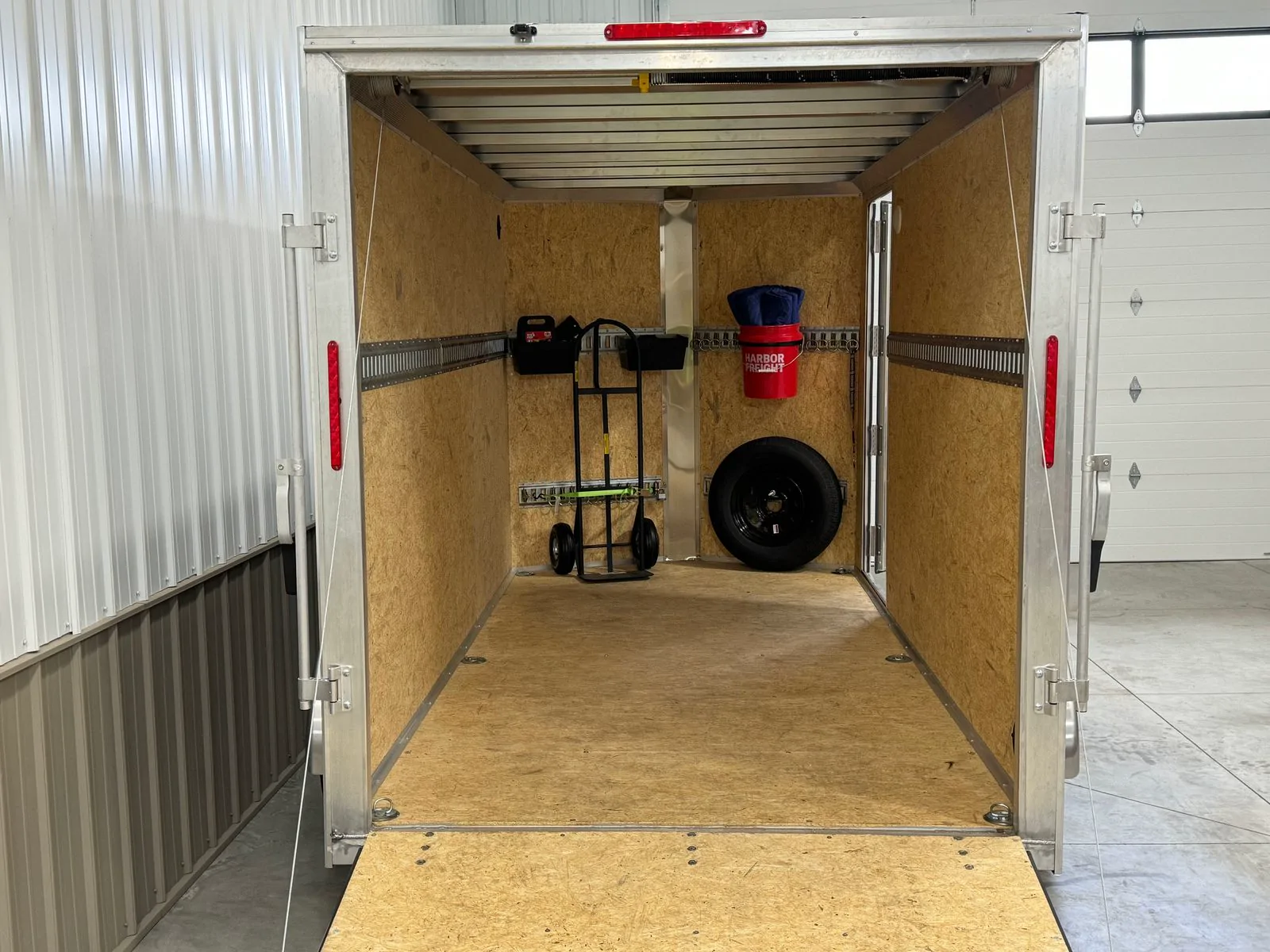
The trailer for this job: Enclosed Trailer — 6' x 12' · dry and lockable. Text Nick at (920) 381-9770 to check a date.
What Is an Open Trailer?
An open trailer — sometimes called a flatbed, utility trailer, or landscape trailer — has a deck, tie-down points, and no sides or roof. Everything on it is exposed to the elements, visible to anyone nearby, and subject to wind and road debris. Open trailers are simpler, lighter, and usually less expensive to rent. They're also easier to load and unload — no ramp configuration needed in most cases, and no height restriction on what you're hauling.
Our open options at Fondy Trailer Rentals include the utility/landscape trailer for lighter loads and the car hauler flatbed for vehicles and heavier equipment.
What Is an Enclosed Trailer?
An enclosed trailer has four walls, a roof, a rear ramp door, and interior tie-down rails. Your load is protected from rain, wind, dust, and prying eyes. Enclosed trailers are heavier than open equivalents, require a larger tow vehicle, and usually cost a bit more to rent. Fondy runs two enclosed options: a 6'×12' enclosed cargo trailer (12 feet long, 6 feet wide, 6'6" tall) for everyday moves and motorcycles, and an 8.5'×24' enclosed car hauler with an electric winch for vehicles, longer hauls, and combined vehicle-plus-household moves.
Side-by-Side: The Real Trade-Offs
| Factor | Open trailer | Enclosed trailer |
|---|---|---|
| Weather | None. A tarp is unreliable at highway speed | Complete. The load arrives as it left |
| Security | Load visible and reachable by anyone | Four walls, roof and a lockable ramp door |
| Loading | Simplest. No ramp setup, no height limit | Rear ramp door, 6' 6" interior height on the 6' x 12' |
| Weight and tow vehicle | Lighter, tows with less | Heavier, needs a larger tow vehicle |
| Cost | Usually less | Usually a bit more |
| Fondy options | 6' x 12' utility, 18ft utility, car hauler | 6' x 12' and 7.5' x 16' enclosed, 8.5' x 24' enclosed car hauler |
Weather Protection
This is where the decision gets made for most Wisconsin renters. If there's any chance of rain — and in Wisconsin from March through November, there's always a chance of rain — and your load can be damaged by moisture, get the enclosed trailer. Full stop.
- Open trailer: Zero weather protection. Furniture, electronics, cardboard boxes, mattresses, anything absorbent will get wet if it rains. Even a tarp is unreliable at highway speed.
- Enclosed trailer: Completely weather-protected. Your load arrives exactly as it left, regardless of what the sky does.
Wisconsin weather reality: East-central Wisconsin averages 30+ inches of rain per year and 50+ inches of snow. Spring and fall storms can appear with 30 minutes of notice. If your load has any moisture sensitivity, this is a real risk on an open trailer.
Security
Open trailers offer no theft security — your load is visible and accessible to anyone. If you're stopping overnight, leaving the trailer unattended, or hauling through populated areas with valuable cargo, an enclosed trailer provides meaningful protection. The rear door locks, and your cargo isn't visible from the road.
Enclosed trailer wins clearly here. For a single-day, never-leaving-your-sight haul, the open trailer is fine. For anything else, enclosed is safer.
Load Access
Open trailers are genuinely easier to load and unload. You can approach from any angle, throw items on without worrying about ceiling height, and use a forklift or skid steer for heavy placement. The enclosed trailer has a fixed interior height (typically 6.5-7 feet), a ramp door that requires a specific setup, and less flexibility for oddly shaped loads.
For bulk materials, landscaping loads, equipment, and anything being loaded with a machine, open beats enclosed on convenience.
Fuel Economy
Open trailers are lighter and have less aerodynamic drag when empty. An enclosed trailer creates a significant wind block behind your tow vehicle. At highway speeds, you'll notice a 15-25% decrease in fuel economy with a loaded enclosed trailer compared to an equivalent open load. On a long haul, this adds up.
Practically: for a day trip around Fond du Lac County, this doesn't matter much. For a round trip to Chicago or Minneapolis, the fuel difference is worth factoring in.
Maneuverability
Enclosed trailers are longer and heavier, which makes them harder to back into tight spaces. If you're navigating through an alley, a storage facility, or a cramped job site, the enclosed trailer's length and height are a liability. Open trailers and utility trailers are generally shorter and more maneuverable.
Rental Cost
Open trailers are typically cheaper to rent than enclosed trailers of similar capacity. The enclosed trailer's added features — walls, roof, ramp door, E-track rails — translate to higher rental rates. If weather and security aren't factors, the open trailer saves you money.
What Should You Actually Rent?
Always Rent Enclosed For:
- Moving household furniture and personal belongings
- Transporting motorcycles (especially to events or long distances)
- Hauling electronics, tools, or anything with high theft value
- Any load that must stay dry — mattresses, upholstered furniture, paper goods
- Long-distance hauls where stopping overnight is possible
- Track days or racing events where your car or motorcycle needs protection in transit
Open Trailer Works Great For:
- Landscaping materials — mulch, gravel, sod, brush (rain doesn't hurt these)
- Lawn equipment — mowers, tillers, aerators
- ATVs and UTVs (though enclosed protects the finish better)
- Construction debris and demo material
- Lumber and building materials (use a tarp if you want to keep them dry)
- Equipment that needs to be loaded with a forklift or skid steer
- Loads too large or tall for enclosed trailer dimensions
The Wisconsin Weather Factor
This deserves its own section because it's genuinely different here than in the Sun Belt or the Pacific Northwest. Wisconsin has four distinct seasons, and three of them involve precipitation that can catch you off guard:
- Spring (March–May): Heavy rain, sometimes sleet. Frost heaves on roads. Cold temps mean wet gear takes forever to dry.
- Summer (June–August): Thunderstorms with no warning. A sunny morning can turn into a 1-inch downpour by noon. Never assume a nice start means a nice finish.
- Fall (September–November): Rain, fog, and early snow by November. Moving furniture in October without an enclosed trailer is a gamble.
- Winter (December–February): Snow and road salt. Open trailers in winter expose your load to spray, road salt, and freezing temps that can damage electronics and certain materials.
Rule of thumb: In Wisconsin, if it's September through May and your load has any moisture sensitivity, pay the extra for enclosed. You won't regret it. You will regret a soaked mattress.
Our Recommendation
When in doubt — especially if you're moving or hauling anything irreplaceable — go enclosed. The price difference between our open and enclosed trailers is modest, and the peace of mind is significant. If you're hauling landscaping materials, bulk goods, or equipment being loaded by machine, open is the efficient and cost-effective choice.
Text Nick at (920) 381-9770 and describe your load. He'll tell you exactly which trailer makes sense before you book. That's the advantage of renting from a local operator who actually knows what the trailers are built for.
Frequently Asked Questions
Is an enclosed trailer worth it over an open one?
If the load cannot get wet, or you need to leave it loaded overnight, yes. An enclosed trailer is dry and lockable. For gravel, brush, mowers and anything you want to load from the side, an open trailer is easier.
What is the price difference?
The 6' x 12' utility trailer starts at $40 for 4 hours and the enclosed trailer at $55.
Is an enclosed trailer harder to tow?
It catches more crosswind, which you notice on an open stretch of Highway 41, and you lose rearward visibility. Neither is a problem at sensible speeds, but allow more room for braking.
How do I book either one?
Text or call Nick at (920) 381-9770. Pickup is at W4637 Lakepark Drive in Fond du Lac by appointment, and every trailer comes back there — we do not do one-way rentals.