Our car hauler is one of the more specialized trailers in the fleet, and it gets used for a surprisingly wide range of jobs. Buying a project car an hour away. Picking up a classic off an estate sale. Running a vehicle to a body shop across the state. Moving a track-day car to Road America. If you need to move a vehicle in Wisconsin and you don't want to hire a tow truck, this is the trailer you want.
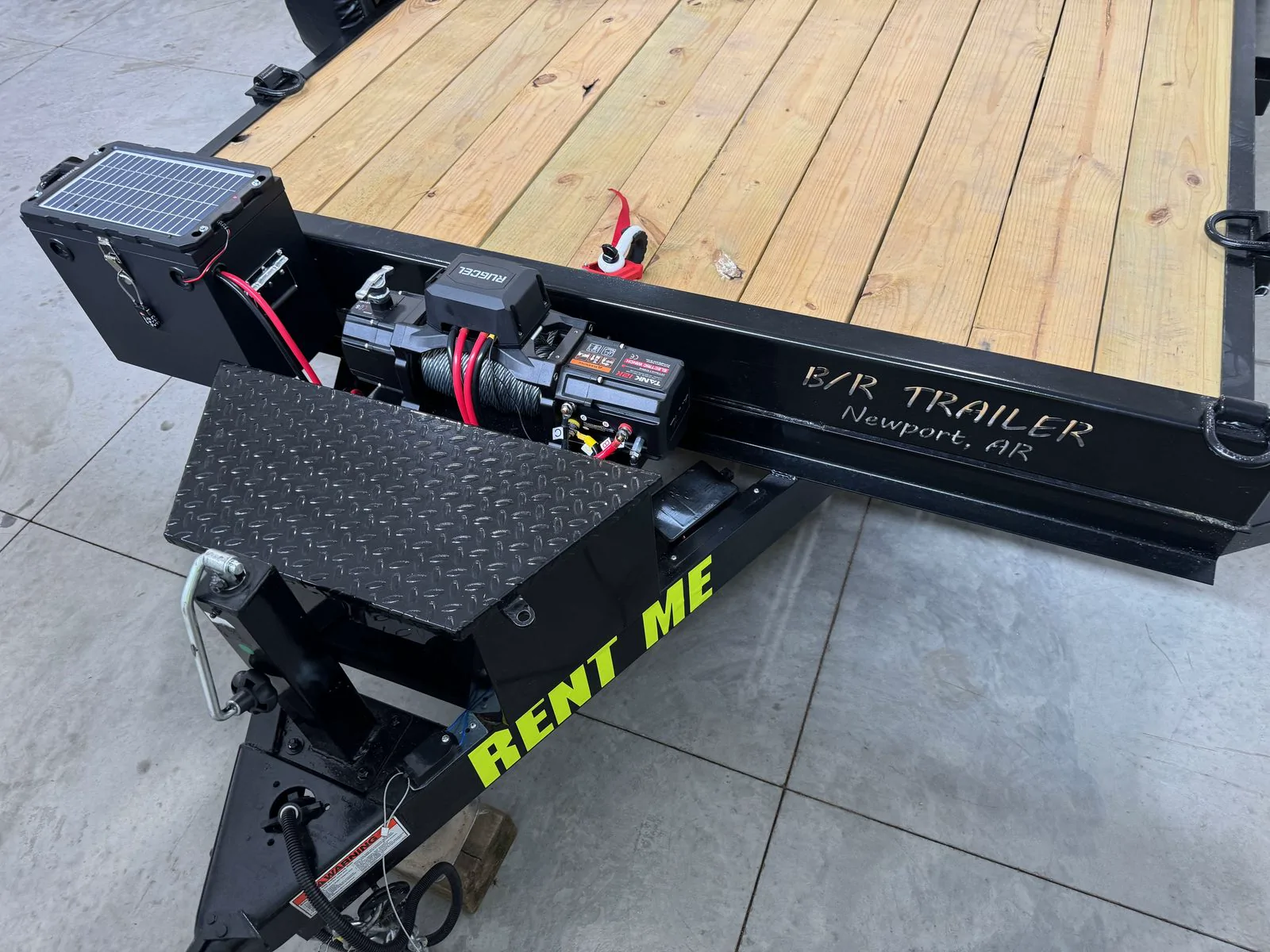
The trailer for this job: Car Hauler — open deck · electric winch. Text Nick at (920) 381-9770 to check a date.
For renters in Fond du Lac, Sheboygan County, and the Fox Valley, this page is the practical version of the decision: what the trailer can handle, what your tow vehicle needs, and when the 20ft car hauler with winch is the right move versus stepping up to a deckover.
What Our Car Hauler Is Built For
Our car hauler is an open flatbed trailer with:
- Electric winch — For non-running, partially running, or low-clearance vehicles that can't be driven up the ramp under their own power
- Loading ramps — Fold-out ramps for driving running vehicles up and onto the deck
- Wheel strap tie-down system — Straps that secure the vehicle at the wheel to prevent movement during transport
- D-ring tie-down points — Additional securement for chains or straps connected to the vehicle's frame
The trailer handles most standard passenger cars, trucks, and SUVs. For very wide vehicles (lifted trucks, large SUVs) or very low vehicles (exotics with ground clearance under 4 inches), call Nick ahead of time to confirm the car hauler is the right fit.
Open Car Hauler vs Enclosed Car Hauler
Fondy now runs two car haulers — the open flatbed described above, and an 8.5' × 24' fully enclosed car hauler with an electric winch. Both haul running and non-running vehicles. The right choice depends on what you're moving and how far.
- Open car hauler — Best for short-distance moves in clear weather, taller vehicles that won't fit in an enclosed box, and quick loading/unloading with maximum visibility.
- Enclosed car hauler — Best for weather protection, long-distance moves, motorcycles or classics you want out of the rain and out of sight, and moves that mix a vehicle plus household cargo. Comes with 20 E-track tie-down points, moving blankets, ratchet straps, a hand truck, a tool kit, and a full-size spare — you can move a car and a household in one trip.
Pricing: the enclosed hauler runs $120 for 4 hours, $140 for 24 hours, $355 for 3 days (15% off), or $735 for a week (25% off). Text Nick to check availability on either.
Running Vehicle Loading Procedure
If the vehicle runs and can be driven, loading is straightforward but requires care:
- Position the trailer on level ground. A slope — especially lateral — makes loading significantly harder and more dangerous. If you can't find level, at minimum ensure you're loading straight uphill, not across a slope.
- Deploy the ramps. Make sure both ramps are fully seated and locked in the load position. A ramp that shifts when the car is halfway up is a serious problem.
- Check ground clearance. The ramp angle creates the lowest clearance point for the vehicle. If the car is low, have a spotter watch the undercarriage as the front bumper clears the ramp-to-trailer transition.
- Drive up slow and straight. Don't rush. Steer straight — a slight angle on the ramp can put wheels off the edge.
- Position the vehicle correctly. The car should be centered on the deck with weight distributed appropriately. Heavier vehicles should be loaded with more weight over the axle, not hung off the back.
- Secure wheel straps and additional tie-downs. Wheel straps go around the tires; use D-rings and ratchet straps for additional frame tie-down points if available. Four-point securement is the standard.
Non-Running Vehicle Loading — Using the Electric Winch
The winch changes everything for non-running vehicles. You don't need a second vehicle, a manual come-along, or a team of people pushing. Here's how to use it correctly:
- Attach the winch hook to the vehicle's tow hook or frame point. Do not hook to bumper trim, plastic panels, suspension arms, or any accessory. Find a structural mounting point — most cars have a dedicated tow hook threaded into the unibody. Check the owner's manual if you're not sure.
- Engage the winch remote or switch. The electric winch slowly pulls the vehicle up the ramps. Keep bystanders clear of the winch line and the path of travel — a snapped winch cable under tension is dangerous.
- Guide the vehicle as it comes up. Have a second person steer if the vehicle still has steering. If the steering is locked, the winch line angle is your steering — keep the pull centered.
- Don't rush the winch. These are rated for the job but aren't designed for high-speed loading. Steady, controlled pull beats racing the winch motor.
- Secure fully when loaded. A non-running vehicle still needs to be fully strapped at all four wheels and any available frame points.
Winch safety: Never stand in line with the winch cable under tension. If it snaps or the hook fails, the cable recoils with dangerous force. Keep people off to the sides.
Is This the Right Trailer for Your Vehicle?
For most running sedans, compact SUVs, half-ton pickups, UTVs, and project vehicles, the car hauler is the right answer. It gives you low-profile ramps, good tie-down points, and the winch for non-runners. If you're transporting a very heavy truck, a large commercial unit, or something extra wide, call Nick first so he can confirm whether the car hauler or one of the larger deckover trailers makes more sense.
If you're not sure whether your tow vehicle, hitch, or brake setup is enough, text the year, make, and model of the vehicle being hauled plus the tow vehicle. It is a quick way to avoid showing up with the wrong setup.
Brake Controller Requirement
Wisconsin law (WI Stat. § 347.37) requires functional brakes on all trailers with a gross weight over 3,000 lbs. A car hauler loaded with a standard sedan is well over this threshold. If your tow vehicle doesn't have a factory-installed brake controller, you need to add one.
Options:
- Plug-in Bluetooth brake controllers (Tekonsha PRODIGY, Redarc, etc.) — These are portable, don't require hardwiring, and can move between vehicles. They're accurate and Wisconsin-compliant.
- Hardwired controllers — Permanent, more integrated, but require installation.
- Ask Nick — If you're not sure about your setup, mention it when you book. He can walk you through what you need.
Tow Vehicle Requirements for Car Hauling
The car hauler plus the vehicle being hauled can easily hit 5,000-8,000 lbs combined. Your tow vehicle needs:
- A towing capacity rated above the combined weight of trailer + vehicle
- A 2-inch ball or 2-5/16" ball (confirm with Nick at booking)
- A working brake controller
- Extended mirrors if the car hauler's load is wider than your tow vehicle
Half-ton pickups (F-150, Ram 1500, Silverado 1500, Sierra 1500) are rated for car hauler use for most standard vehicles when properly equipped. For heavier trucks, full-size SUVs, or commercial vehicles, a three-quarter-ton or one-ton truck gives you additional margin and confidence.
Common Car Hauler Use Cases in Wisconsin
Buying a Private-Party Vehicle Out of Area
This is the most common reason people rent the car hauler. You found a clean truck in Green Bay, a project Camaro in Milwaukee, or a diesel pickup in the Fox Valley. Renting our car hauler for the day is dramatically cheaper than paying a towing company or flatbed service to pick it up. You drive to the seller, load it up, and bring it back — all for a flat rental rate with no mileage fees.
Shop Runs for Unregistered or Non-Running Vehicles
Moving a project car to a body shop, an engine-out car to a machine shop, or a barn find to your garage — these all require a car hauler if the vehicle can't be driven legally. The electric winch handles the barn find that's been sitting since 1987. The open deck handles the car with a missing hood or door that can't go in an enclosed trailer.
Dealership Fleet Transport
Small dealerships and auto auction buyers use our car hauler for moving inventory. Renting beats owning when the need isn't daily.
Track Days at Road America (Elkhart Lake)
Road America draws track-day participants from across the Midwest, including plenty of renters coming through east-central Wisconsin. Many track cars aren't street-legal or aren't suitable for a 2-hour freeway drive. Our car hauler is the tool for getting your car from your garage to the track and back safely.
Pricing and Booking the Car Hauler
Car hauler rates are available by the 4-hour window, full day, and multi-day. Text Nick at (920) 381-9770 with your dates, what you're hauling, and where you're picking up the vehicle. For non-running vehicles, mention it so he can make sure the winch is set up and ready before you arrive.
Frequently Asked Questions
What does a car hauler rental cost?
The open car hauler starts at $80 for 4 hours. The 8.5' x 24' enclosed car hauler is the weather-protected option. 24-hour, 3-day and weekly rates are available on both.
Does the car hauler come with a winch?
Yes. The car hauler has an electric winch and ramps, which is what makes loading a non-running vehicle possible on your own.
Do I need a brake controller for the car hauler?
The car hauler, utility trailer, dump trailer and gooseneck all require a brake controller. If your vehicle does not have one, we rent a Bluetooth controller.
Can I take a car hauler across state lines?
No. There are no mileage limits on any rental. You pay for the time, not the distance, and the only restriction is that the trailer stays inside the United States.