Hauling a motorcycle isn't complicated once you know what you're doing, but there are enough details — soft ties, wheel chocks, strap routing — to make first-timers nervous. This guide covers the full process from choosing the right trailer to arriving at your destination with the bike exactly as it left your garage.
The trailer for this job: Enclosed Trailer — 7.5' x 16' · our biggest cargo bay. Text Nick at (920) 381-9770 to check a date.
Why Enclosed Trailer Beats Open for Motorcycles
Open trailers work in a pinch, but for a motorcycle — especially a quality bike you care about — the enclosed trailer is clearly the better choice on most Wisconsin rides and trips:
- Paint and finish protection — A 2-hour highway run at 65 mph behind an open truck generates road debris, sand, and bugs that sandblast any exposed surface. Painted bodywork, chrome, and polished metal take the hit. An enclosed trailer eliminates this entirely.
- Weather protection — Wisconsin rain is a constant variable May through October. Your bike arrives clean and dry regardless of what happens between pickup and destination.
- Security when parked — Stopping for lunch, parking overnight at an event — an enclosed and lockable trailer keeps the bike invisible and inaccessible. An open trailer with a bike visible from the road invites unwanted attention.
- Gear and luggage storage — The enclosed trailer's interior holds helmets, jackets, saddlebags, tools, and event gear securely while you ride. You don't need to pack the bike to the gills for multi-day events.
For longer trips to events like Sturgis, Daytona, or rallies in northern Wisconsin, the enclosed trailer is the right choice.
Dimensions — Does Your Bike Fit?
Our 6'×12' enclosed trailer has approximately 12 feet of usable floor length. The rear ramp provides the loading path. Interior height is 6'6" — well clear of any street motorcycle, cruiser, or sport bike. Wide cruisers and bikes with extended handlebars may be 32-38 inches wide; this presents no issues in the trailer's roughly 6-foot interior width. One motorcycle fits with plenty of room for gear; two motorcycles can fit nose-to-tail if both are reasonably short standard-length bikes.
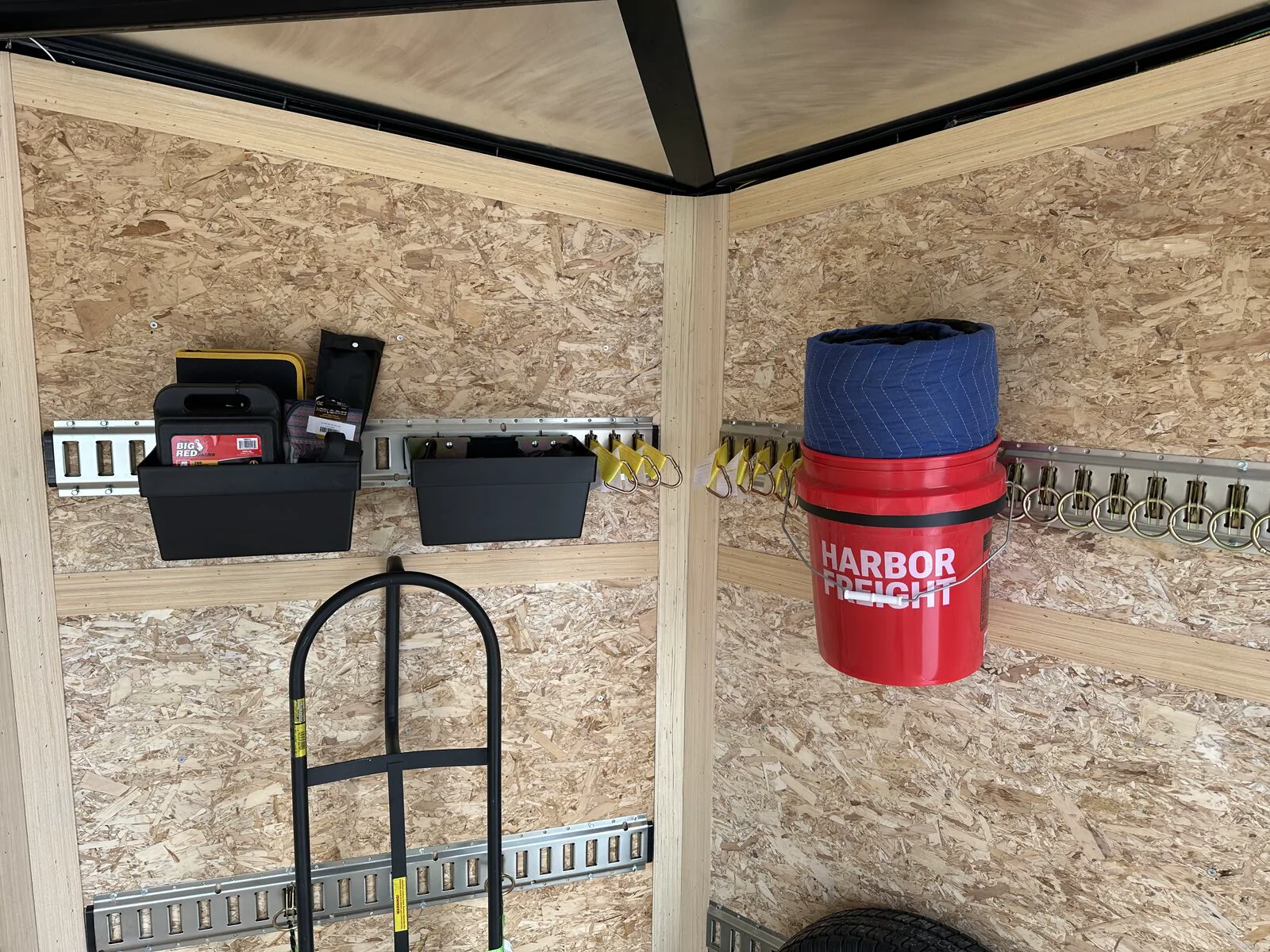
Hauling three or more bikes, or riding to Sturgis/Daytona with a group? Fondy also has an 8.5'×24' enclosed car hauler that fits multiple bikes side-by-side with room for gear, coolers, and event supplies. It includes 20 E-track tie-down points, ratchet straps, moving blankets, and a hand truck. Text Nick if you need the bigger box.
One standard motorcycle loads with plenty of room to spare. Two motorcycles loaded side by side and staggered front/rear work comfortably in a 20-foot trailer. Three medium-sized bikes can fit if you're efficient about positioning.
Equipment You Need
Wheel Chock
A wheel chock holds the front wheel upright and prevents the bike from rolling forward or backward when you release it during strapping. Without a chock, getting the bike centered and stable while also managing straps is a two-person job at minimum. A chock makes it manageable solo.
Chocks bolt or clamp to the trailer floor. If you're renting our enclosed trailer for motorcycle transport, ask Nick if a chock is available. If not, purchase or rent one from a motorcycle accessories shop — they're $40-80 and worth every dollar.
Soft Ties (for the Handlebars)
Soft ties are short loops of padded webbing that attach to the motorcycle's handlebars and provide a secure attachment point for ratchet straps without damaging the handlebar finish or levers. They're the correct way to attach front straps to most motorcycles.
Do not loop straps directly around bare metal handlebars — the strap webbing will scratch the chrome or painted finish under tension. Do not hook strap hooks to brake levers, clutch levers, or brake line brackets — these are not load-bearing attachment points and can be damaged or broken.
Ratchet Straps — Soft Tie Ends Preferred
Ratchet straps with soft loops (instead of metal J-hooks) at the attachment end are ideal for motorcycles. Metal hooks catch on bodywork, fairings, and cables. Soft-loop straps loop through the handlebars or tie-down points without sharp contact.
You need a minimum of four straps for a properly secured motorcycle: two front and two rear. Six straps (adding belly-down straps for longer trips) provides additional security.
Loading Procedure — Step by Step
- Position the trailer on level ground. A level loading surface makes everything easier. The motorcycle won't want to roll sideways on a tilted trailer.
- Set up the wheel chock at the appropriate position. Place it roughly two-thirds of the way to the front of the trailer so the bike's loaded center of gravity is forward of the axle.
- Walk the bike up the ramp. For most street bikes, you can walk the bike up the ramp in neutral with one person. Don't try to ride it up unless you have a very long ramp and experience doing it — rolling a motorcycle inside a trailer enclosure is risky for the bike and the person doing it.
- Roll the front wheel into the chock. The chock locks the front wheel in place and holds the bike upright. If you don't have a chock, use a helper to hold the bike while you install straps.
- Attach soft ties to the handlebars. Loop the soft ties around the handlebar tubes (not levers or cables).
- Attach front ratchet straps. Connect from the soft ties to D-rings or E-track anchors on the front trailer walls at a forward-and-downward angle. Ratchet to medium tension — enough to compress the front suspension slightly (about 1/2 inch). Don't fully bottom out the suspension.
- Attach rear straps. Two straps from strong rear points (grab handles, rear frame loops, or subframe tie-down hooks if equipped) to rear trailer anchors. Angle rearward and downward.
- Check the bike. Push on it from the front, rear, and sides. It should feel solid with essentially no movement. Some minor flex is normal; rocking or tipping is not.
- Raise and secure the ramp. Ensure the ramp is fully latched before moving.
Common Mistakes
- Over-tensioning front straps. Compressing the front suspension to full bottom-out stresses fork seals and springs. Moderate compression (1/2 inch, not full travel) is sufficient and safe.
- Strapping to plastic bodywork or fairings. These are cosmetic panels; they're not structural and can crack or break under strap tension. Always attach to frame or handlebar attachment points.
- Using only two straps (front only). A motorcycle strapped only at the front can rock rearward and fall backward during hard braking. You need rear straps too.
- Not using a wheel chock and then losing the bike when releasing it to adjust. A bike without a chock will immediately want to fall over when you're not holding it. Get a chock or bring a helper.
- Forgetting to re-check strap tension after the first mile. Motorcycle tie-downs settle as the suspension compresses slightly during initial movement. Stop after the first mile and retighten if needed.
Popular Wisconsin Riding Events — Planning Your Haul
From Fond du Lac, these Wisconsin motorcycle events are popular destinations for hauled bikes:
- Lac du Flambeau Bikers Jamboree (3.5 hours north) — Annual summer rally in Vilas County; attract thousands of riders from the Midwest
- Road America at Elkhart Lake — Superbike and MotoAmerica rounds bring track-day riders and spectators with trailers throughout the racing season
- Thunderbird Harley-Davidson events (Milwaukee, 60 miles) — Dealer events and group rides that riders trailer to and from
- Door County rides (2 hours northeast) — Peninsula with spectacular riding roads; many riders trailer to Sturgeon Bay or Sister Bay and ride from there to avoid the freeway miles
With no mileage limits on our enclosed trailer rental, you can haul to any of these destinations — and back — at a flat rate. Text Nick at (920) 381-9770 to book the trailer for your next Wisconsin motorcycle trip.
Frequently Asked Questions
What trailer should I use for a motorcycle?
The 7.5' x 16' enclosed trailer is the usual choice, because it keeps the bike dry and out of sight. An open utility trailer works for a short haul in good weather.
Can I fit two bikes side by side?
Yes, two motorcycles fit side by side in the 7.5' x 16' enclosed trailer with room to strap each one down.
What do I tie the bike down with?
Every trailer goes out stocked: ratchet straps, D-rings, ramps, a spare tire, bottle jack, lug wrench and work gloves. You do not need to bring hauling gear.
Do you have a ramp for loading?
Yes, ramps come with the trailer. Load with the bike in gear and a second person steadying it if you can.