One of the most common questions we get from first-time renters: "My truck has a trailer plug — is that all I need?" For light trailers, yes. For the heavier trailers in our fleet, you also need a brake controller. This guide explains what a brake controller does, when Wisconsin law requires one, how to get one if your truck doesn't have it, and how to use it correctly during your rental.
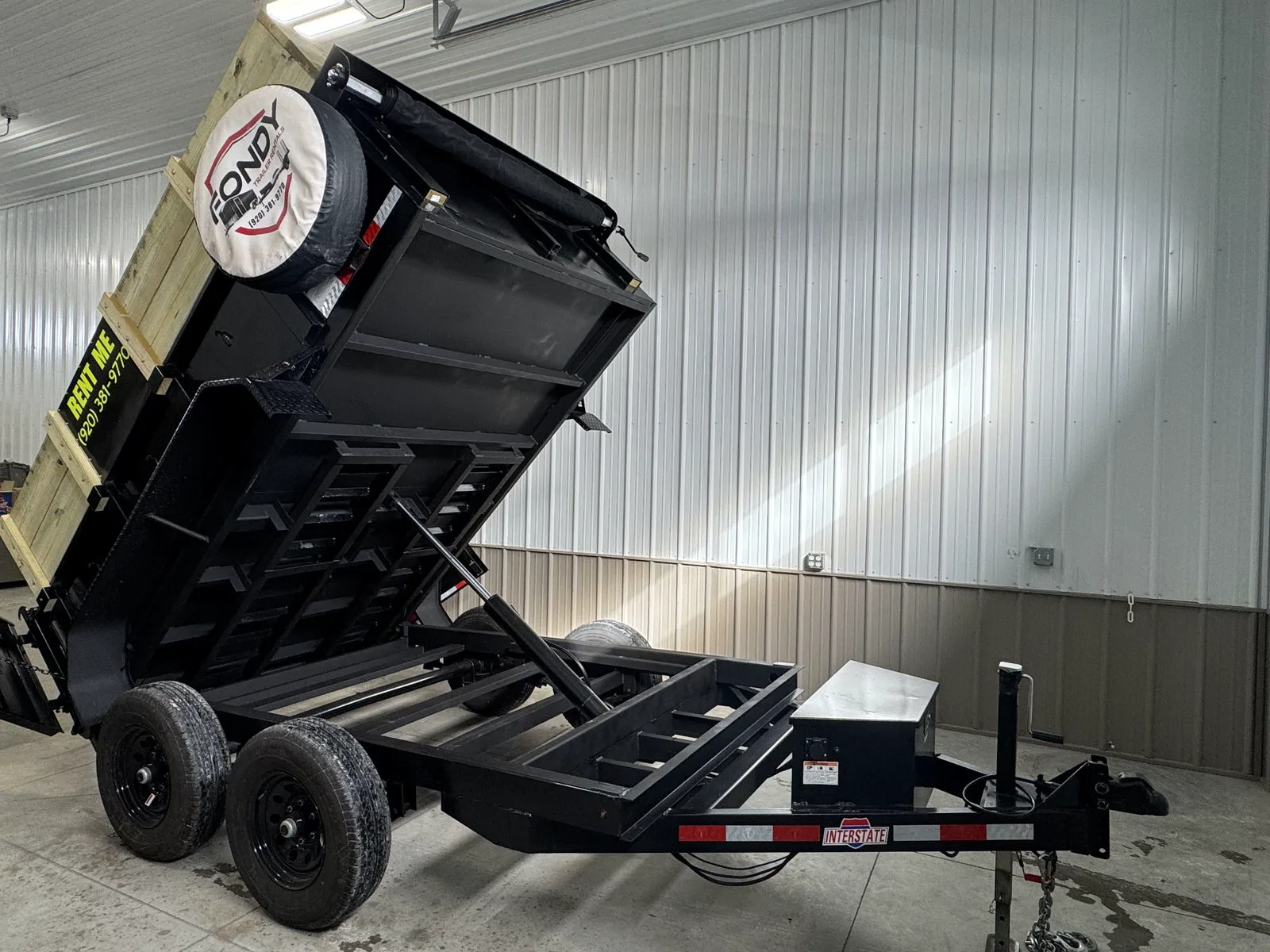
The trailer for this job: Dump Trailer — 6' x 10' · remote dump. Text Nick at (920) 381-9770 to check a date.
What Does a Brake Controller Do?
Many trailers — particularly heavier ones — are equipped with electric trailer brakes. These are drum or disc brakes on the trailer's axle that activate via an electrical signal from the tow vehicle. Without an electric signal, the trailer has no braking capability of its own. The tow vehicle's brakes do all the stopping for the combined weight of truck plus trailer.
At light loads and low speeds, this can be manageable. At highway speeds with a loaded gooseneck, dump trailer, or car hauler, it's genuinely dangerous. A brake controller solves this by:
- Detecting when you apply the truck's brakes
- Sending a proportional electrical signal to the trailer's brake magnets
- Causing the trailer's brakes to apply in proportion to how hard you're braking
- Distributing the braking effort across all axles — both truck and trailer — rather than overloading just the truck's brakes
The result: shorter stopping distances, less heat in the truck's brakes, and significantly more stable stopping behavior (the trailer doesn't push the tow vehicle during hard braking).
Wisconsin Law on Trailer Brakes
Wisconsin Statute § 347.37 requires brakes on all trailers with a gross weight exceeding 3,000 lbs when loaded. This applies to any trailer being operated on public roads in Wisconsin.
Key points:
- The 3,000 lb threshold is the loaded weight — not the trailer's empty weight
- If your trailer can be loaded to exceed 3,000 lbs (and most utility, dump, car hauler, and gooseneck trailers can), you need trailer brakes and a brake controller when you load it beyond that threshold
- Operating a trailer over this weight without functional trailer brakes is a moving violation
- If the trailer's brakes are non-functional due to no brake controller, the legal exposure is on the driver of the tow vehicle
Practical rule: If you're renting our dump trailer, car hauler, gooseneck, or a loaded enclosed trailer for a significant move, assume you need a brake controller. When in doubt, text Nick and he'll tell you whether your planned load will require one.
Does Your Truck Already Have a Brake Controller?
Many modern trucks — especially those equipped from the factory with a tow package — have an integrated brake controller built in. Here's how to check:
- Check the dashboard or infotainment screen — Most factory-equipped brake controllers show up as a setting or menu in the truck's display. Ford Super Duty, Ram 2500/3500, GM 2500HD/3500HD, and Toyota Tundra (2022+) commonly include them in tow packages.
- Check the owner's manual — Look up "trailer brake controller" in the index. It will tell you if one is installed and how to access the settings.
- Look for a trailer connector with a 7-pin round or 7-blade flat plug — If your truck has a 7-pin connector, it has the wiring for electric trailer brakes. But the brake controller must also be present — wiring alone isn't enough.
- Look for a controller module — Some older trucks have aftermarket controllers installed under the dash or on the left A-pillar. These are rectangular or oval plastic units with a display and a slide or dial.
What If Your Truck Doesn't Have a Brake Controller?
You have two options: install one before your rental, or use a portable Bluetooth controller.
Hardwired Aftermarket Brake Controllers
Traditional brake controllers like the Tekonsha Prodigy P3 or Tekonsha Sentinel wire into the truck's brake signal wire and mount under or near the dash. Installation takes 1-3 hours depending on your truck. These are reliable and permanent — once installed, they work with any electric brake trailer you tow in the future. Cost: $70-150 for the controller, plus installation if you don't do it yourself.
Portable Bluetooth Brake Controllers
A newer category: Bluetooth accelerometer-based controllers that plug into the truck's 7-pin connector and communicate wirelessly with a phone app. The most well-known is the Redarc Tow-Pro and the Tekonsha Prodigy iD. These don't require hardwiring — they plug in at the trailer connector and use the truck's trailer power wire.
Advantages:
- No installation required — plug in and pair via app
- Portable across multiple vehicles
- Accurate proportional braking using an accelerometer
- Wisconsin-compliant for electric brake trailers
Limitations:
- Requires a compatible smartphone and the associated app
- More expensive than basic hardwired units ($150-280)
- App reliability varies; always test before your rental day
How to Use the Brake Controller on Your Rental
Calibration
After connecting the trailer, most brake controllers need to be calibrated or gain-adjusted for the specific load. Gain controls how aggressively the trailer brakes engage relative to the tow vehicle's braking input. Too low: the trailer brakes apply too gently, doing little to help stop the combined rig. Too high: the trailer brakes lock up prematurely, causing skidding and potential jackknifing.
Calibration procedure (general — check your controller's manual for specifics):
- Find a safe, empty parking lot
- Drive at approximately 25 mph
- Apply medium braking — enough to feel the brakes but not enough to panic stop
- If you feel the trailer pushing from behind (understeer), gain is too low — increase it
- If the trailer skids or jerks, gain is too high — decrease it
- Repeat until stops feel smooth and proportional
Manual Override
All brake controllers have a manual override function — a button or slide that applies the trailer brakes independently of the truck's brakes. This is useful in two scenarios:
- Testing: Apply the manual override at low speed to confirm the trailer brakes are working before getting on the highway
- Sway correction: If the trailer begins to sway on the highway, pressing the manual override applies trailer brakes without braking the tow vehicle, which tends to pull the trailer back into line. Do NOT apply the tow vehicle's brakes during a sway event — this can make it worse.
Which Fondy Trailers Require a Brake Controller?
- Gooseneck trailer — Yes, always. This trailer at load will significantly exceed 3,000 lbs.
- Dump trailer — Yes, when loaded. An empty dump trailer may be under threshold; a loaded one almost certainly exceeds it.
- Car hauler — Yes, when loaded with a vehicle. Any standard passenger car puts the combined weight over 3,000 lbs.
- 6'×12' enclosed trailer — Depends on load. The trailer itself is around 1,500 lbs; lightly loaded it may stay under 3,000 lbs gross. A move with appliances and furniture easily pushes past that. When in doubt, have a brake controller ready.
- Utility/landscape trailer — Typically no for light loads. Check your specific load weight.
When you text Nick to book, mention your tow vehicle. He'll tell you whether you need a brake controller for your planned rental and load.
Frequently Asked Questions
Which Fondy trailers need a brake controller?
The car hauler, utility trailer, dump trailer and gooseneck all require a brake controller. If your vehicle does not have one, we rent a Bluetooth controller.
Can I rent a brake controller instead of installing one?
Yes. We rent a Bluetooth brake controller, so you do not have to wire anything into your dash to take a braked trailer out for a day.
What happens if I tow a braked trailer without a controller?
The trailer brakes do not engage, so all the stopping is done by your vehicle. On a loaded trailer that means much longer stopping distances, and in Wisconsin a trailer over 3,000 lb is required to have working brakes. Rent the controller instead.
Do I need a controller for the enclosed trailer?
The four that require one are the car hauler, utility trailer, dump trailer and gooseneck. Tell Nick which trailer and which tow vehicle you have when you book and he will confirm before you drive over.